
Hypertension has become one of the world’s most silent but dangerous modern epidemics. Often called the “quiet killer,” elevated blood pressure slowly damages arteries, strains the heart, and increases the risk of stroke — usually without causing any clear symptoms until it’s too late.
What’s more concerning is that stress, poor sleep, inflammation, and modern lifestyle habits continue pushing blood pressure numbers higher, even among younger adults.
But alongside conventional treatments, scientists are now turning their attention back to natural compounds with cardioprotective potential — and one of the most fascinating among them is Panax ginseng, also known as Korean ginseng.
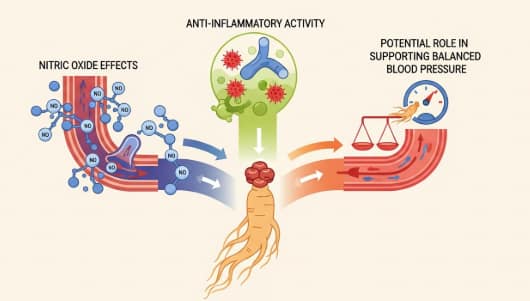
Traditionally prized as a vitality and longevity herb, ginseng is now being studied for its potential to support healthy blood pressure through mechanisms that influence vascular function, nitric oxide production, stress hormones, and inflammation.
This article breaks down what modern research really says.
❤️ Why Blood Pressure Matters More Than Ever
Persistent high blood pressure can damage the cardiovascular system in three primary ways:
1. It stiffens arteries
Over time, pressure against artery walls triggers inflammation and micro-damage, leading to arterial stiffness.
2. It forces the heart to work harder
The left ventricle thickens, eventually weakening heart output.
3. It accelerates atherosclerosis
Tiny tears in blood vessels allow plaque to form, raising the risk of heart attack and stroke.
According to the World Health Organization, hypertension contributes to more than 10 million deaths yearly, making it one of the top preventable causes of mortality worldwide.
Because of this, any compound capable of supporting cardiovascular balance naturally is worth investigating — and ginseng is showing surprising promise.
🌿 How Ginseng May Influence Blood Pressure
Panax ginseng contains ginsenosides, the active compounds responsible for its adaptogenic and medicinal effects. Over 40 ginsenosides have been identified, and several appear to influence cardiovascular function.
Here are the scientifically studied mechanisms:
1. Ginseng Improves Nitric Oxide (NO) Production
Nitric oxide relaxes blood vessels, allowing them to widen — a process known as vasodilation.
A study published in the American Journal of Hypertension found that red ginseng increases nitric oxide synthesis, leading to improved arterial relaxation and reduced vascular resistance.
🔗 External reference:
https://pubmed.ncbi.nlm.nih.gov/ (search “ginseng nitric oxide”)
This effect may help support healthy blood pressure levels, especially in individuals with endothelial dysfunction (a common factor in hypertension).
2. Ginseng Helps Reduce Stress-Induced Blood Pressure Spikes
Stress is one of the most underestimated drivers of hypertension.
Ginseng is an adaptogen — meaning it helps modulate the body’s stress response.
Research shows it can lower circulating stress hormones like cortisol while stabilizing the autonomic nervous system.
This is particularly relevant because:
- Stress → activates sympathetic nervous system
- Sympathetic activation → constricts blood vessels
- Result → increased blood pressure
By reducing this chain reaction, ginseng supports more stable cardiovascular responses during daily stress.
3. Ginseng Improves Arterial Flexibility
Healthy arteries expand and contract easily. Hypertension hardens them.
Human trials have shown that ginseng improves arterial compliance — meaning it helps blood vessels stay flexible.
In a randomized controlled trial, adults who took Korean Red Ginseng for 12 weeks showed significant improvements in arterial stiffness indicators.
Improved arterial elasticity can contribute to better blood pressure regulation.
4. Anti-Inflammatory Effects Reduce Vascular Damage
Chronic inflammation is one of the root causes of endothelial dysfunction and hypertension.
Ginsenosides Rg3, Rb1, and Rg1 have been shown to:
- Reduce inflammatory cytokines (TNF-α, IL-6)
- Lower oxidative stress
- Protect blood vessel linings from micro-injury
A review in Frontiers in Pharmacology described ginseng as having “broad-spectrum vascular protective effects.”
This makes it a supportive companion for long-term cardiovascular wellness.
5. Potential Regulation of the Renin–Angiotensin System (RAS)
Some early studies suggest that ginseng may help modulate the RAS pathway, which regulates:
- Blood pressure
- Fluid balance
- Electrolyte levels
Although research is still developing, this could add another mechanism explaining its cardiovascular influence.
🔬 What Human Studies Say About Ginseng and Blood Pressure
Let’s look at the clinical data:
✔️ Study 1: Korean Red Ginseng Slightly Lowers Blood Pressure in Hypertensive Patients
A meta-analysis of randomized trials found that Korean Red Ginseng modestly reduces both systolic and diastolic blood pressure in people with mild hypertension.
The effect was more pronounced in individuals with elevated baseline levels.
✔️ Study 2: Significant Improvements in Arterial Stiffness
A double-blind study reported that 2–3 g/day of Panax ginseng for 12 weeks:
- Improved flow-mediated dilation
- Reduced arterial stiffness
- Lowered oxidative stress markers
These changes are clinically meaningful for long-term cardiovascular protection.
✔️ Study 3: No Significant BP Change in Healthy Adults
Interestingly, in normotensive (normal blood pressure) individuals, ginseng showed no strong blood-pressure-lowering effect.
This suggests ginseng may act as a balancing adaptogen — supporting high numbers without pushing normal ones too low.
⚖️ Is Ginseng Safe for People With Hypertension?
For most people, yes — especially when taken in moderate doses and from a reputable source.
However, some precautions:
- Ginseng may interact with blood-pressure medications
- High doses may cause overstimulation in sensitive individuals
- Always choose pure, standardized, Korean-origin ginseng for clinical reliability
In general, studies show ginseng is well tolerated and may provide cardiovascular benefits when used appropriately.
🌟 Why Korean Red Ginseng Is the Most Researched Form
Steamed and dried Panax ginseng — known as Korean Red Ginseng — contains higher concentrations of ginsenosides like:
- Rg3
- Rh2
- Compound K
These have stronger vasodilatory and anti-inflammatory effects.
This is why Korean Red Ginseng consistently outperforms regular white ginseng in cardiovascular studies.
🇰🇷 Premium Korean Ginseng Online Shop
(as requested)


