The Global Challenge of Hypertension
Hypertension, or high blood pressure, remains one of the most persistent and silent health threats worldwide. The World Health Organization (WHO) estimates that over 1.2 billion adults live with elevated blood pressure, with nearly half unaware of their condition. Uncontrolled hypertension increases the risk of heart attack, stroke, kidney disease, and cognitive decline — making it a critical target for both prevention and management.
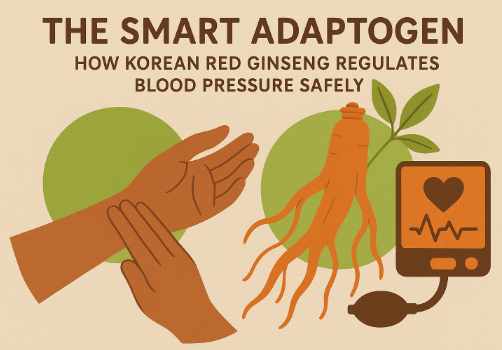
While conventional treatments focus on pharmacological intervention, modern medical science increasingly recognizes the role of adaptogenic herbs in supporting cardiovascular balance. Among these, Korean Red Ginseng (Panax ginseng C.A. Meyer) stands out as one of the most thoroughly researched botanical adaptogens, known for its dual ability to energize the body and normalize physiological stress responses — including blood pressure regulation.
Understanding Blood Pressure and the Body’s Regulatory System
Blood pressure is maintained through a complex interplay between the heart, blood vessels, kidneys, and nervous system. The autonomic nervous system adjusts heart rate and vascular tone, while the renin-angiotensin-aldosterone system (RAAS) manages fluid balance and vascular resistance.
When these mechanisms become overactive — often due to stress, aging, or endothelial dysfunction — blood vessels constrict, increasing systemic pressure. Over time, this damages arterial walls, reducing elasticity and promoting inflammation and oxidative stress.
Traditional antihypertensive drugs, though effective, can sometimes lead to unwanted side effects such as fatigue or hypotension. This is where adaptogens like Korean Red Ginseng show promise — by modulating rather than forcing physiological balance.
Korean Red Ginseng: The Adaptogenic Regulator
The term adaptogen refers to natural substances that enhance the body’s ability to adapt to stress and restore homeostasis. Korean Red Ginseng is unique because it acts bidirectionally — it can raise or lower blood pressure depending on what the body requires.
This property comes from its rich array of ginsenosides, bioactive compounds that influence multiple systems simultaneously:
- They improve vascular tone by enhancing nitric oxide (NO) synthesis,
- Support autonomic balance between the sympathetic (“fight or flight”) and parasympathetic (“rest and digest”) systems,
- And promote antioxidant defense, reducing inflammation and oxidative stress within the endothelium.
This smart regulation distinguishes Korean Red Ginseng from typical stimulants or vasodilators — it doesn’t push the body in one direction, but instead helps it return to equilibrium.
Scientific Mechanisms: Ginsenosides and Vascular Function
More than 40 ginsenosides have been identified in Korean Red Ginseng, with Rg1, Rb1, Rg3, and Re being most relevant to cardiovascular health.
1. Nitric Oxide Pathway Activation
Studies published in the Journal of Ethnopharmacology (2012) demonstrated that ginsenoside Rg3 enhances endothelial nitric oxide synthase (eNOS) activity, leading to increased nitric oxide (NO) production. NO is a critical molecule that promotes vasodilation, or the widening of blood vessels, thus improving circulation and reducing vascular resistance.
2. Antioxidant and Anti-inflammatory Action
Hypertension is often linked to chronic oxidative stress. Research in Phytotherapy Research (2018) showed that ginseng extract reduces reactive oxygen species (ROS) and inhibits NF-κB activation, thereby protecting arterial walls from inflammation-induced damage.
3. Sympathoadrenal Balance
Unlike caffeine or other stimulants, ginseng does not chronically elevate sympathetic activity. Instead, it helps rebalance the autonomic nervous system, reducing overactivation of stress hormones like norepinephrine — a mechanism described in a 2020 Nutrients review on adaptogenic regulation.
Together, these mechanisms explain why Korean Red Ginseng can help both hypertensive and hypotensive individuals — supporting balance through homeostasis rather than linear stimulation.
Clinical Evidence: Korean Red Ginseng and Blood Pressure Regulation
Several controlled trials support ginseng’s adaptogenic role in blood pressure control.
- A 2006 randomized clinical trial (Hypertension Research, 29:161–166) found that participants consuming 3 g/day of Korean Red Ginseng for 8 weeks showed a significant reduction in systolic blood pressure and improved endothelial function without lowering diastolic pressure excessively.
- Another double-blind study (American Journal of Chinese Medicine, 2011) revealed that ginseng extract improved arterial compliance and microcirculation among adults with metabolic syndrome, indicating enhanced vascular flexibility.
- Interestingly, some studies also show that in cases of low blood pressure, ginseng can increase cardiac output modestly, illustrating its adaptive duality.
Overall, clinical evidence points toward Korean Red Ginseng’s normalizing, not suppressive effect — supporting cardiovascular function safely across various baseline conditions.
Korean Red Ginseng vs. Other Ginseng Varieties
While American (Panax quinquefolius) and Siberian (Eleutherococcus senticosus) ginsengs share similar adaptogenic qualities, Korean Red Ginseng remains superior for cardiovascular regulation due to its unique ginsenoside profile and traditional steam-processing method.
Steaming enhances the concentration of Rg3, Rg5, and Rh2, compounds shown to exert stronger effects on endothelial function and nitric oxide production. This makes Korean Red Ginseng more potent for vascular health and blood pressure modulation compared to white or unprocessed ginsengs.
Practical Use and Safety
Korean Red Ginseng is generally considered safe when taken within recommended doses (1–3 g/day of standardized extract).
However, individuals already taking antihypertensive medication should consult their healthcare provider, as ginseng’s vasodilatory effects may potentiate the action of certain drugs.
The World Health Organization (WHO Monographs, 2019) confirms that Panax ginseng is safe for long-term use when standardized properly, with minimal adverse effects.
Conclusion: A Balanced Heart through Adaptogenic Intelligence
Korean Red Ginseng exemplifies the future of natural cardiovascular care — intelligent, adaptive, and evidence-based.
Unlike synthetic drugs that act narrowly, ginseng engages the body’s own regulatory systems, enhancing resilience and restoring balance.
Its adaptogenic intelligence allows it to lower high blood pressure or support circulation when low, maintaining harmony within the cardiovascular network.
As modern science continues to explore plant-based solutions for complex health issues, Korean Red Ginseng stands as a model for natural precision medicine — bridging tradition and biomedical innovation.
🇰🇷 Premium Korean Ginseng Online Shop