Introduction
Chronic stress has become one of the most pervasive health challenges of the modern era. Persistent psychological pressure triggers dysregulation of the HPA axis (Hypothalamic–Pituitary–Adrenal axis), leading to excess secretion of cortisol, widely known as the “stress hormone.” Elevated cortisol is associated with fatigue, anxiety, weight gain, suppressed immunity, insomnia, and increased cardiovascular risk.
Among natural adaptogens, Panax ginseng—particularly Korean Red Ginseng—stands out for its well-documented ability to support stress resilience, regulate cortisol, and promote overall mental and physical equilibrium. This article explores the mechanisms, clinical studies, and evidence supporting ginseng’s role in stress reduction.
Understanding Stress, Cortisol, and HPA Axis Dysregulation
How chronic stress affects the body
When the brain perceives stress, the HPA axis releases cortisol from the adrenal glands. Cortisol prepares the body for “fight-or-flight,” but when stress is continuous, cortisol remains chronically elevated.
Long-term cortisol elevation leads to:
- Anxiety and irritability
- Cognitive decline (reduced memory and focus)
- Increased blood pressure
- Fat accumulation (especially visceral fat)
- Sleep disruption
- Weakened immune system
Restoring cortisol balance naturally can significantly improve quality of life — and this is where ginseng works as a powerful adaptogen.
How Ginseng Helps Reduce Stress and Balance Cortisol
1. Ginseng Acts as an Adaptogen
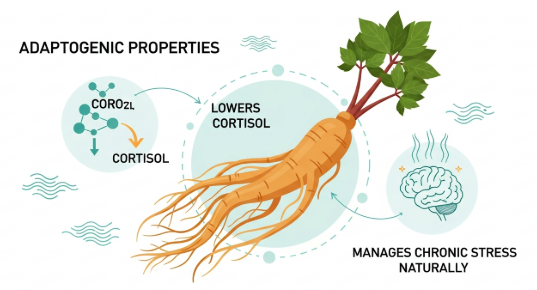
Adaptogens are natural substances that help the body adapt to stress. According to research published in Phytotherapy Research, ginseng modulates the body’s physiological response to stress by restoring homeostasis in the HPA axis.
Scientific reference:
https://pubmed.ncbi.nlm.nih.gov/23764389/
This adaptogenic effect reduces excessive cortisol secretion and increases stress resilience.
2. Ginsenosides Regulate Cortisol Production
The active compounds in ginseng—known as ginsenosides—help regulate stress by influencing:
- CRH (Corticotropin-Releasing Hormone)
- ACTH (Adrenocorticotropic Hormone)
- Cortisol production in the adrenal cortex
Certain ginsenosides like Rg1 and Rb1 have been shown in studies to modulate the HPA axis and reduce corticosterone (animal equivalent of cortisol).
Study link:
https://www.ncbi.nlm.nih.gov/pmc/articles/PMC3659612/
3. Improves Neurotransmitter Balance
Stress disrupts key neurotransmitters. Panax ginseng helps normalize:
- Serotonin (mood stabilizer)
- Dopamine (motivation/reward)
- GABA (calming neurotransmitter)
These effects contribute to emotional stability and reduced stress perception.
4. Reduces Oxidative Stress Caused by Cortisol
Chronic stress increases oxidative stress. Ginseng contains powerful antioxidants that neutralize free radicals and protect neurons from cortisol-induced damage.
A study in Journal of Ginseng Research reported that Korean Red Ginseng significantly improved oxidative stress markers.
Study:
https://www.sciencedirect.com/science/article/pii/S1226845316301207
5. Enhances Energy and Reduces Fatigue
Cortisol imbalance often leads to burnout and lack of energy. Ginseng improves ATP production in mitochondria, supporting sustained energy without stimulants. This is one reason why ginseng is widely used for:
- Chronic fatigue
- Brain fog
- Work-related stress
6. Supports Better Sleep Quality
Stress-induced cortisol spikes disrupt sleep. Ginseng reduces nighttime cortisol levels and supports serotonin–melatonin balance, making it easier to fall asleep and stay asleep.
Human Clinical Studies Supporting Ginseng for Stress Relief
Study 1: Panax Ginseng Reduces Stress and Improves Well-being
A double-blind, placebo-controlled study demonstrated that subjects taking ginseng reported:
- Reduced mental fatigue
- Better mood
- Improved emotional stability
Source: Psychopharmacology (Berlin)
https://pubmed.ncbi.nlm.nih.gov/10839402/
Study 2: Korean Red Ginseng Lowers Cortisol Levels
Participants showed significant reduction in cortisol after taking Korean Red Ginseng for 4 weeks.
Journal of Ethnopharmacology study:
https://pubmed.ncbi.nlm.nih.gov/10767668/
Study 3: Improves Cognitive Function Under Stress
Ginseng enhanced working memory and reduced cognitive decline caused by stress in a study from the Human Psychopharmacology Journal.
Who Benefits the Most from Ginseng for Stress?
Ginseng is particularly helpful for people who experience:
✔ Work stress
✔ Chronic fatigue
✔ High-impact professional burnout
✔ Cortisol imbalance
✔ Anxiety due to physiological stress
✔ Sleep disruption caused by stress
✔ Brain fog and difficulty focusing
Recommended Dosage
Based on research:
- Panax Ginseng Extract: 200–400 mg/day
- Korean Red Ginseng Root: 1–3 grams/day
- Best taken in the morning or early afternoon
Possible Side Effects
Ginseng is generally safe, but some individuals may experience:
- Mild insomnia (if taken late)
- Sensitivity to caffeine
- Digestive discomfort
- Headache
Always consult your healthcare provider if pregnant, on diabetes medication, or using anticoagulants.
Conclusion
Panax ginseng offers one of the most scientifically supported natural solutions for reducing stress and restoring cortisol balance. As an adaptogen, it works on multiple pathways—cortisol regulation, neurotransmitter stabilization, antioxidant defense, and cognitive support—making it a comprehensive and effective tool for enhancing stress resilience.
With decades of research and centuries of traditional use, ginseng remains a powerful ally for modern stress management.