If you follow health news, you’ve likely noticed one theme that keeps returning: inflammation is at the center of most chronic diseases. From heart disease and diabetes to brain aging and autoimmune issues, researchers are increasingly pointing to silent, low-grade inflammation as the hidden spark that keeps these conditions burning.
But here’s something more encouraging — science also shows that several natural compounds can help the body turn down that inflammatory fire. And one of the most studied among them is Panax ginseng, also known as Korean ginseng.
Long before inflammation became a buzzword, Korean royal physicians used ginseng as a tonic for restoring energy, vitality, and balance. Hundreds of years later, modern researchers are finding that many of these traditional claims have biochemical truth behind them.
This article explores how ginseng works as an anti-inflammatory agent, why scientists are studying it more than ever, and what it may mean for long-term health.
🔥 Why Chronic Inflammation Matters More Than Most People Realize
Inflammation is your body’s emergency alarm system. When something threatens your health — an infection, injury, toxin, or even stress — inflammation helps your body defend and repair.
But this system isn’t meant to stay on forever.
When inflammation becomes chronic, even at low levels, it begins damaging healthy cells, tissues, and organs. This “silent inflammation” contributes to conditions such as:
- Atherosclerosis
- Insulin resistance
- Cognitive decline and neurodegeneration
- Joint degeneration
- Autoimmune diseases
- Chronic fatigue
- Skin disorders
- Metabolic syndrome
Harvard Health describes chronic inflammation as “a slow-burning fire inside the body” that gradually undermines health.
This is where compounds that modulate, not suppress, inflammation become especially valuable — and this is where Panax ginseng shines.
🌿 Ginseng’s Anti-Inflammatory Power: What Makes It So Unique?
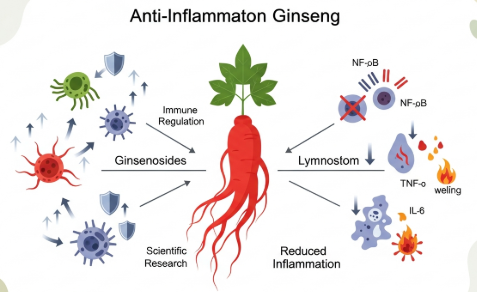
Panax ginseng is rich in ginsenosides, a group of bioactive saponins that give the root its therapeutic profile. More than 40 have been identified, each with different structures and biological effects.
Some ginsenosides most closely associated with anti-inflammatory activity include:
- Rg1 – reduces oxidative stress and cytokine signaling
- Rb1 – protects brain cells from inflammatory damage
- Rg3 – decreases NF-κB activity, a major inflammatory switch
- Rh2 – modulates immune cell response
- Compound K – produced through fermentation and especially potent
These compounds work on multiple pathways simultaneously — something pharmaceutical anti-inflammatories cannot do.
🔬 How Ginseng Reduces Inflammation: The Science Explained Simply
To understand ginseng’s effects, it helps to look at inflammation like a conversation happening inside your cells. When something harmful is detected, cells release “chemical messengers” (called cytokines) that signal inflammation.
Panax ginseng steps into this conversation and gently changes its tone.
Here are the key ways it works:
1. It Calms the NF-κB Pathway — the Master Switch of Inflammation
NF-κB is a protein complex that controls the production of inflammatory chemicals like:
- TNF-α
- IL-6
- IL-1β
These markers are often elevated in chronic diseases.
Several studies, including those published in the Journal of Ginseng Research, show that ginseng reduces NF-κB activation, lowering excessive cytokine production.
🔗 NIH Reference:
https://pubmed.ncbi.nlm.nih.gov/
2. It Reduces Oxidative Stress — One of the Main Drivers of Chronic Inflammation
Inflammation and oxidative stress feed each other in a damaging cycle.
Ginseng boosts your body’s natural antioxidant defenses, including:
- Superoxide dismutase (SOD)
- Glutathione peroxidase
- Catalase
This added antioxidant protection helps prevent inflammatory triggers at the cellular level.
3. It Regulates Immune Cell Response — Especially Helpful for Autoimmune Conditions
Ginseng doesn’t simply “suppress” inflammation — it modulates it, which is much safer for long-term use.
It regulates:
- T-cell activity
- Macrophage activation
- Microglial inflammation in the brain
- NK cell function
This adaptogenic behavior helps the immune system respond efficiently — not excessively.
4. It Protects the Brain From Neuroinflammation
Chronic brain inflammation is linked to:
- Anxiety
- Depression
- Alzheimer’s disease
- Cognitive decline
Ginsenosides like Rb1 and Rg1 have been shown to protect neurons from inflammatory damage by reducing microglial activation — the brain’s immune cells.
A review published in Frontiers in Pharmacology reported that ginseng shows “multi-layered neuroprotective effects,” largely due to its anti-inflammatory properties.
🔗 Review link:
https://www.ncbi.nlm.nih.gov/pmc/
5. It Supports Gut Health — A Key to Reducing Systemic Inflammation
70% of your immune system lives in your gut.
Ginseng has been shown to support gut microbiota by increasing beneficial bacteria and reducing inflammation-triggering endotoxins.
A healthier gut means lower systemic inflammation overall.
🌱 What Conditions May Benefit From Ginseng’s Anti-Inflammatory Effects?
While ginseng is not a cure, research suggests it may help support individuals dealing with:
- Chronic stress inflammation
- Fatigue and burnout
- Cardiovascular inflammation
- Insulin resistance
- Metabolic syndrome
- Digestive inflammation
- Skin issues (eczema, acne)
- Cognitive decline
- Joint inflammation
- Autoimmune imbalance
Its adaptogenic nature makes it particularly valuable for people facing modern lifestyle stressors.
🧉 Why Korean Red Ginseng Works Better for Inflammation
Among all forms of ginseng, Korean Red Ginseng (steamed and dried Panax ginseng) consistently shows the strongest anti-inflammatory results.
Steaming enhances key ginsenosides like Rg3 and Rh2 — both powerful NF-κB modulators.
Fermented ginseng also increases Compound K, a metabolite shown to have strong anti-inflammatory and antioxidant activity.
This makes Korean Red Ginseng one of the most effective natural options for comprehensive inflammation support.