Introduction
Ginseng benefits for cardiovascular and heart health have attracted growing scientific interest as heart disease remains a leading global health concern. Cardiovascular disease accounts for nearly one-third of all deaths worldwide, according to the World Health Organization (WHO). Therefore, researchers continue to explore natural compounds that may support heart health alongside standard medical care. Among traditional medicinal herbs, ginseng stands out due to its long history of use and expanding body of clinical research.
Ginseng, especially Panax ginseng (Korean ginseng), contains active compounds called ginsenosides. These bioactive molecules influence inflammation, oxidative stress, blood vessel function, and metabolic health. In this article, we examine how ginseng may support cardiovascular and heart health using evidence-based, medically responsible information.
Medical disclaimer: This article is for educational purposes only and is not a substitute for professional medical advice. Always consult a qualified healthcare provider before starting any supplement.
Understanding Ginseng and Its Active Compounds
Ginseng refers to the root of plants in the Panax genus. The most studied forms include:
- Panax ginseng (Korean or Asian ginseng)
- Panax quinquefolius (American ginseng)
The cardiovascular effects of ginseng are mainly linked to ginsenosides, which exert antioxidant, anti-inflammatory, and vasomodulatory actions.
According to the National Institutes of Health (NIH), ginsenosides interact with multiple cellular pathways involved in vascular tone, lipid metabolism, and glucose regulation. As a result, ginseng has become a focus of integrative cardiovascular research.
How Ginseng Benefits Cardiovascular and Heart Health
1. Supporting Healthy Blood Pressure Regulation
Hypertension is a major risk factor for heart disease and stroke. Several studies suggest that ginseng may help support normal blood pressure levels.
- Ginsenosides enhance nitric oxide production, which relaxes blood vessels.
- Improved vasodilation may reduce vascular resistance.
- This effect supports smoother blood flow.
A randomized controlled trial published in Journal of Hypertension reported modest blood pressure improvements in adults using standardized Korean red ginseng.
Source: https://pubmed.ncbi.nlm.nih.gov/25608195/
Importantly, ginseng does not replace antihypertensive medication. However, it may serve as a complementary lifestyle support when approved by a healthcare professional.
2. Improving Cholesterol and Lipid Profiles
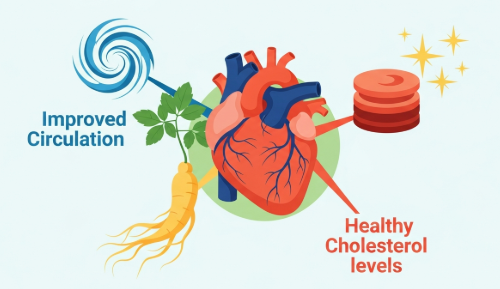
Dyslipidemia contributes directly to atherosclerosis. Research indicates that ginseng benefits cardiovascular and heart health by influencing lipid metabolism.
Potential effects include:
- Reduced LDL (“bad”) cholesterol oxidation
- Increased HDL (“good”) cholesterol activity
- Improved triglyceride balance
A systematic review in Nutrition Research found that ginseng supplementation showed favorable effects on total cholesterol and LDL levels in some populations.
Source: https://pubmed.ncbi.nlm.nih.gov/30122547/
Therefore, ginseng may support heart health when combined with dietary and lifestyle interventions.
3. Enhancing Endothelial Function and Circulation
The endothelium lines blood vessels and regulates vascular tone. Endothelial dysfunction is an early marker of cardiovascular disease.
Studies show that ginseng:
- Protects endothelial cells from oxidative damage
- Enhances nitric oxide bioavailability
- Improves microcirculation
According to research published in Frontiers in Pharmacology, Korean red ginseng demonstrated protective effects against endothelial dysfunction through antioxidant pathways.
Source: https://www.frontiersin.org/articles/10.3389/fphar.2018.00095/full
This mechanism is a key reason why ginseng benefits cardiovascular and heart health in aging populations.
4. Reducing Oxidative Stress and Inflammation
Chronic inflammation and oxidative stress drive plaque formation in arteries. Ginseng contains potent antioxidants that help neutralize free radicals.
Key actions include:
- Suppression of inflammatory cytokines
- Reduction of oxidative LDL damage
- Protection of heart muscle cells
The National Center for Complementary and Integrative Health (NCCIH) recognizes ginseng’s antioxidant activity as one of its most studied properties.
Source: https://www.nccih.nih.gov/health/ginseng
By addressing inflammation, ginseng may help support long-term cardiovascular resilience.
5. Supporting Blood Sugar Control for Heart Protection
Cardiovascular risk rises significantly in individuals with insulin resistance or type 2 diabetes. Ginseng may help support glucose metabolism, which indirectly protects heart health.
Evidence suggests that ginseng:
- Improves insulin sensitivity
- Reduces post-meal blood glucose spikes
- Supports metabolic balance
A meta-analysis in PLOS One reported modest improvements in fasting blood glucose among adults using ginseng supplements.
Source: https://journals.plos.org/plosone/article?id=10.1371/journal.pone.0107391
Better glucose control reduces vascular damage, supporting overall heart health.
Korean Red Ginseng vs. Other Forms for Heart Health
Not all ginseng products are the same. Korean red ginseng undergoes a steaming process that alters ginsenoside composition.
| Feature | Korean Red Ginseng | American Ginseng |
|---|---|---|
| Ginsenoside profile | Higher Rg3, Rh1 | Higher Re |
| Cardiovascular research | Extensive | Moderate |
| Traditional use | Energy, circulation | Glycemic balance |
For cardiovascular support, standardized Korean red ginseng extracts are most commonly studied.
Safety, Dosage, and Medical Considerations
Ginseng is generally well tolerated when used responsibly. However, safety remains essential.
Potential considerations:
- May interact with blood thinners (e.g., warfarin)
- May affect blood pressure or blood sugar levels
- Not recommended during pregnancy without medical advice
Typical studied doses range from 200–400 mg of standardized extract daily. Always follow product labeling and professional guidance.
The European Medicines Agency (EMA) emphasizes using ginseng as a traditional herbal supplement, not a drug replacement.
Source: https://www.ema.europa.eu/en/medicines/herbal/panax-ginseng
Who May Benefit Most from Ginseng?
Ginseng may be particularly helpful for:
- Adults with mild cardiovascular risk factors
- Individuals seeking antioxidant support
- People focused on preventive heart health
However, patients with diagnosed heart disease must consult their cardiologist before use.
Conclusion
Scientific evidence suggests that ginseng benefits for cardiovascular and heart health through multiple mechanisms, including improved circulation, antioxidant protection, lipid regulation, and metabolic support. While ginseng is not a cure or replacement for medical treatment, it may serve as a valuable complementary option within a heart-healthy lifestyle.
As emphasized by organizations such as WHO and NIH, herbal supplements should be used responsibly and based on evidence. When combined with balanced nutrition, physical activity, and medical supervision, ginseng may support long-term cardiovascular wellness.
Frequently Asked Questions (FAQ)
Is ginseng proven to prevent heart disease?
No. Ginseng may support cardiovascular health but does not prevent or treat heart disease.
Can ginseng lower blood pressure naturally?
Some studies suggest modest support for healthy blood pressure, but results vary.
Is Korean red ginseng better for heart health?
It is the most studied form for cardiovascular benefits.
Can I take ginseng with heart medication?
Always consult a healthcare professional due to possible interactions.
How long does it take to see benefits?
Most studies observe effects after 8–12 weeks of consistent use.
🇰🇷 Premium Korean Ginseng Online Shop