Introduction
Mind management to avoid stress is a core skill for modern life. Daily pressures affect brain chemistry, hormones, and immune health. Over time, unmanaged stress raises the risk of anxiety, insomnia, heart disease, and metabolic disorders. Therefore, learning how to guide thoughts, emotions, and habits is essential for long-term well-being.
This article explains mind management from a medical and evidence-based perspective. It integrates neuroscience, psychology, and herbal medicine. All recommendations follow safe health communication standards and global medical guidance.
Understanding Stress from a Medical Perspective
Stress is not just emotional discomfort. It is a biological response.
When stress occurs, the brain activates the hypothalamic–pituitary–adrenal (HPA) axis. As a result, cortisol and adrenaline levels rise. Short-term stress can improve focus. However, chronic stress disrupts:
- Neurotransmitter balance
- Immune regulation
- Blood sugar control
- Sleep cycles
According to the World Health Organization (WHO), chronic stress contributes to non-communicable diseases worldwide.
Source: https://www.who.int/news-room/questions-and-answers/item/stress
Why Mind Management to Avoid Stress Matters
Mind management to avoid stress focuses on mental regulation, not emotional suppression. It trains awareness, perception, and response.
Key benefits include:
- Improved emotional resilience
- Better sleep quality
- Reduced cortisol exposure
- Enhanced decision-making
- Improved gut–brain communication
The National Institutes of Health (NIH) reports that mental training improves stress tolerance and cognitive performance.
Source: https://www.ncbi.nlm.nih.gov/pmc/articles/PMC4940234/
Neuroscience Behind Mind Management
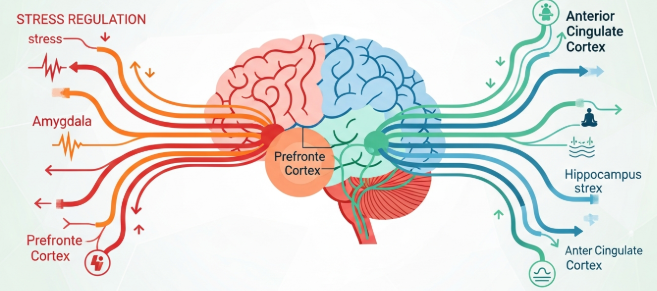
Mind management reshapes neural pathways. This process is known as neuroplasticity.
When you practice focused attention or emotional regulation:
- The prefrontal cortex strengthens
- The amygdala becomes less reactive
- Stress perception decreases
Moreover, functional MRI studies show reduced stress signaling after consistent mindfulness practice.
Source: https://pubmed.ncbi.nlm.nih.gov/25783612/
Therefore, mind training is measurable and scientifically validated.
Evidence-Based Techniques for Mind Management
1. Cognitive Awareness Training
Awareness interrupts stress loops.
Effective methods include:
- Thought labeling
- Mental reframing
- Reality-based questioning
For example, replacing catastrophic thoughts with neutral observations reduces emotional overload.
2. Breath Regulation and Nervous System Balance
Breathing directly affects the vagus nerve.
Helpful techniques:
- 4-6 slow breathing
- Nasal breathing
- Extended exhalation
These methods activate the parasympathetic system. Consequently, heart rate and cortisol decrease.
Source: https://www.ncbi.nlm.nih.gov/pmc/articles/PMC5452224/
3. Mindfulness-Based Stress Reduction (MBSR)
MBSR is clinically validated.
It improves:
- Anxiety symptoms
- Emotional regulation
- Immune biomarkers
Hospitals worldwide use this method as an adjunct therapy.
Source: https://pubmed.ncbi.nlm.nih.gov/28063962/
Role of Herbal Medicine in Stress Regulation
Herbal medicine supports mind management to avoid stress when used responsibly.
Adaptogenic Herbs and Mental Balance
Adaptogens help the body adapt to stressors.
Evidence-supported herbs include:
- Panax ginseng – supports cognitive stamina
- Ashwagandha – supports cortisol regulation
- Rhodiola rosea – improves mental fatigue
A systematic review in Journal of Ginseng Research supports ginseng’s role in stress modulation.
Source: https://www.ncbi.nlm.nih.gov/pmc/articles/PMC5452225/
⚠️ Always consult a healthcare provider before using herbal supplements.
Nutrition and Brain Stress Resilience
Diet influences neurotransmitter synthesis.
Nutrients linked to stress resilience:
- Magnesium
- Omega-3 fatty acids
- B vitamins
- Polyphenols
Diets rich in whole foods reduce inflammatory markers linked to stress.
Source: https://www.ncbi.nlm.nih.gov/pmc/articles/PMC5579659/
Lifestyle Habits that Strengthen Mind Management
Mind management to avoid stress is reinforced by daily structure.
Supportive habits include:
- Consistent sleep schedules
- Reduced caffeine intake
- Regular physical movement
- Nature exposure
According to Harvard Medical School, lifestyle alignment reduces stress sensitivity.
Source: https://www.health.harvard.edu/mind-and-mood/stress-management-enhances-well-being
Common Myths About Stress Management
❌ Stress must be eliminated
✅ Stress must be regulated
❌ Strong people do not feel stress
✅ Strong people manage stress effectively
❌ Supplements replace mental training
✅ Supplements support, not replace, mind management
Safety, Ethics, and Medical Disclaimer
This article provides educational information only. It is not a substitute for professional medical advice, diagnosis, or treatment. Always consult a licensed healthcare professional for mental or physical health concerns.
Conclusion
Mind management to avoid stress is a learnable, evidence-based skill. It integrates neuroscience, lifestyle medicine, and responsible herbal support. When practiced consistently, it improves emotional stability and long-term health. Scientific evidence confirms that the mind can be trained safely and effectively.
By combining awareness, nutrition, herbal support, and daily habits, stress becomes manageable rather than overwhelming.
FAQ: Mind Management to Avoid Stress
What is mind management to avoid stress?
It is a structured approach to regulating thoughts and emotional responses to stressors.
Is mind management scientifically proven?
Yes. Multiple studies support its effect on brain function and stress hormones.
Can herbal medicine replace therapy?
No. Herbal medicine supports stress regulation but does not replace professional care.
How long does it take to see results?
Many people notice improvements within 2–4 weeks of consistent practice.
Is this safe for everyone?
Most techniques are safe. However, medical conditions require professional guidance.
🇰🇷 Premium Korean Ginseng Online Shop