Introduction
Ginseng for immune booster support has become a widely discussed topic in integrative and preventive health. As immune resilience gains attention worldwide, many people seek herbal options that are supported by credible science rather than anecdotal claims. Ginseng, particularly Panax ginseng and Panax quinquefolius, has been studied extensively for its immunomodulatory properties. This article examines how ginseng supports immune function, what the scientific evidence shows, and how it can be used safely within an evidence-based health framework.
Importantly, this content follows medical best practices and Google Health guidelines. It does not replace professional medical advice. Instead, it provides well-referenced educational information to support informed decision-making.
Understanding the Immune System and Immune Support
The immune system is a complex network of cells, tissues, and signaling molecules. Its primary role is to defend the body against pathogens such as bacteria, viruses, and fungi. However, immune function is not simply “strong” or “weak.” It must remain balanced.
Key Components of Immune Function
- Innate immunity: The body’s first line of defense, including macrophages and natural killer (NK) cells
- Adaptive immunity: Antibody-producing B cells and T lymphocytes
- Immune signaling: Cytokines and chemokines that regulate immune responses
Therefore, effective immune support focuses on regulation and balance, not overstimulation. This is where herbal adaptogens such as ginseng may play a role.
What Is Ginseng? A Medicinal Plant with a Long Clinical History
Ginseng refers to the root of plants in the Panax genus. The word “Panax” comes from Greek, meaning “all-healing,” reflecting its traditional medicinal use.
Main Types of Medicinal Ginseng
- Panax ginseng (Korean or Asian ginseng)
- Panax quinquefolius (American ginseng)
Both varieties contain bioactive compounds known as ginsenosides, which are responsible for most of ginseng’s physiological effects.
The World Health Organization (WHO) recognizes Panax ginseng as a medicinal herb used to enhance physical and mental capacity during fatigue and recovery periods.
Source: https://apps.who.int/medicinedocs/en/d/Js4924e/
How Ginseng for Immune Booster Support Works
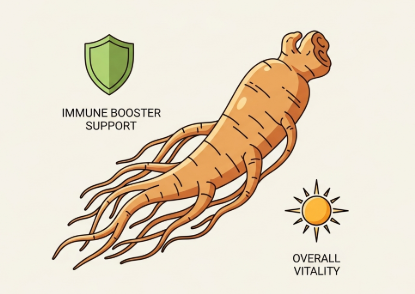
The role of ginseng for immune booster support lies in its immunomodulatory, not immunostimulatory, action. This distinction is essential from a medical safety perspective.
Key Immune Mechanisms Identified in Research
- Enhances activity of natural killer (NK) cells
- Supports macrophage and dendritic cell function
- Modulates cytokine production to reduce immune imbalance
- Helps regulate inflammation during immune responses
Because of these effects, ginseng may support immune readiness without causing excessive immune activation.
A review published in Journal of Ginseng Research highlights ginseng’s ability to regulate both innate and adaptive immunity.
Source: https://www.ncbi.nlm.nih.gov/pmc/articles/PMC5452221/
Scientific Evidence Supporting Ginseng and Immune Health
Human Clinical Studies
Several randomized controlled trials have evaluated ginseng’s immune effects:
- A double-blind study showed improved NK cell activity in healthy adults using standardized ginseng extract.
Source: https://pubmed.ncbi.nlm.nih.gov/20812270/ - Research involving older adults demonstrated fewer upper respiratory infections when ginseng supplementation was used.
Source: https://pubmed.ncbi.nlm.nih.gov/12514289/
These studies suggest potential benefits for immune maintenance, especially in populations with age-related immune decline.
Laboratory and Preclinical Findings
In vitro and animal studies provide mechanistic insights:
- Ginsenosides enhance antigen presentation
- Reduced oxidative stress during immune activation
- Improved immune cell signaling pathways
The National Institutes of Health (NIH) acknowledges ginseng’s immune-related bioactivity while emphasizing the need for standardized dosing.
Source: https://www.nccih.nih.gov/health/ginseng
Ginseng Compared with Other Immune-Supporting Herbs
While many herbs are marketed for immunity, their mechanisms differ.
Comparison Overview
- Echinacea: Short-term immune stimulation
- Elderberry: Antioxidant and antiviral support
- Turmeric: Anti-inflammatory modulation
- Ginseng: Adaptogenic immune regulation
Because of its adaptogenic nature, ginseng is often considered suitable for longer-term immune maintenance rather than acute infection treatment.
Safety, Dosage, and Clinical Considerations
Safety is a critical aspect of any immune-related supplement.
General Safety Profile
According to the WHO and NIH, ginseng is generally safe when used appropriately. However, individual factors matter.
Typical Dosage Ranges
- Standardized extract: 200–400 mg per day
- Dried root: 1–2 grams per day
Dosage should follow product labeling and professional guidance.
Potential Interactions
Ginseng may interact with:
- Anticoagulant medications
- Blood pressure medications
- Immunosuppressive therapies
Therefore, individuals with chronic conditions should consult a healthcare professional before use.
Who May Benefit from Ginseng for Immune Booster Support
Ginseng is not a cure or treatment. However, it may be appropriate for:
- Adults experiencing chronic fatigue
- Older individuals with reduced immune responsiveness
- People under prolonged physical or mental stress
Importantly, ginseng is not recommended during acute infections without medical advice.
Choosing High-Quality Ginseng Products
Product quality significantly affects safety and efficacy.
Evidence-Based Selection Criteria
- Clear botanical name (Panax ginseng)
- Standardized ginsenoside content
- Third-party quality testing
- Transparent sourcing
Korean red ginseng is among the most researched forms due to its standardized processing methods.
Conclusion
Ginseng for immune booster support represents a scientifically studied option within integrative health. Its immune-modulating properties, supported by human and laboratory research, suggest potential benefits for maintaining immune balance rather than overstimulation. When used responsibly and under professional guidance, ginseng can be part of a broader evidence-based wellness strategy.
This article is for educational purposes only and is not a substitute for professional medical advice. Always consult a qualified healthcare provider before starting any herbal supplement.
Frequently Asked Questions (FAQ)
Is ginseng proven to boost immunity?
Clinical studies suggest ginseng supports immune regulation and cell activity, but it is not a medical treatment.
How long does ginseng take to support immune function?
Most studies observe effects after 4–12 weeks of consistent use.
Can ginseng be taken daily?
Yes, when used within recommended dosages and under professional guidance.
Is ginseng safe for everyone?
Not always. People with medical conditions or taking medications should consult a healthcare provider.
🇰🇷 Premium Korean Ginseng Online Shop