Introduction
As people age, many experience a gradual reduction in physical stamina, mental focus, and overall vitality. This process, often described as age-related energy decline, affects daily productivity and quality of life. Increasingly, scientific interest has focused on ginseng for age-related energy decline as a natural option that may help support energy metabolism, stress adaptation, and healthy aging. Importantly, this interest is driven by both traditional use and modern clinical research.
Unlike stimulants that offer short-lived effects, ginseng works through complex biological pathways. Therefore, it is often discussed within the context of long-term vitality and resilience rather than instant energy boosts.
Understanding Age-Related Energy Decline
Age-related energy decline is not a disease. Instead, it is a multifactorial physiological process. Several interconnected mechanisms contribute to this condition.
Key biological factors include:
- Reduced mitochondrial efficiency, leading to lower cellular energy production
- Hormonal changes, particularly involving cortisol and sex hormones
- Increased oxidative stress and low-grade inflammation
- Declining muscle mass and oxygen utilization
According to the National Institute on Aging (NIA), these changes can begin as early as midlife and progress gradually
https://www.nia.nih.gov/health/what-happens-body-aging
Because these factors interact, effective support strategies should address more than one pathway. This is where adaptogenic herbs, such as ginseng, become relevant.
What Is Ginseng? A Medicinal Root with Scientific Recognition
Ginseng refers primarily to plants in the Panax genus, meaning “all-healing” in Greek. The most studied form is Panax ginseng, commonly known as Korean or Asian ginseng.
Active compounds in ginseng
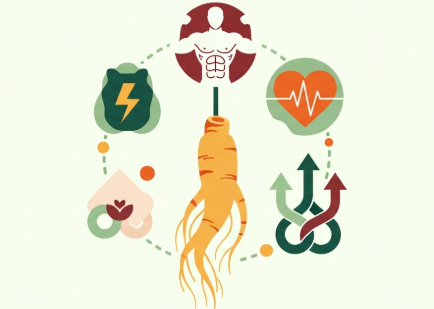
The therapeutic properties of ginseng are largely attributed to ginsenosides. These bioactive compounds influence:
- Energy metabolism
- Neurotransmitter balance
- Immune modulation
- Stress response regulation
The World Health Organization (WHO) recognizes Panax ginseng as a medicinal plant with documented traditional use
https://apps.who.int/medicinedocs/en/d/Js4926e/
Importantly, modern pharmacological research supports many of these traditional applications.
How Ginseng for Age-Related Energy Decline Works
Cellular energy and mitochondrial support
One of the most relevant mechanisms involves mitochondrial function. Studies published in Journal of Ginseng Research indicate that ginsenosides may improve mitochondrial efficiency and reduce oxidative damage
https://www.sciencedirect.com/science/article/pii/S1226845318300784
As a result, cells may produce energy more efficiently, which is critical for aging individuals.
Stress adaptation and adrenal balance
Chronic stress accelerates fatigue, especially with age. Ginseng is classified as an adaptogen. Therefore, it helps the body adapt to physical and mental stressors without overstimulation.
Research indexed on PubMed suggests that Panax ginseng modulates the hypothalamic-pituitary-adrenal (HPA) axis
https://pubmed.ncbi.nlm.nih.gov/29099038/
This mechanism supports sustained energy rather than short-term stimulation.
Cognitive and Physical Benefits Linked to Energy Levels
Energy decline is not limited to physical fatigue. Cognitive stamina also decreases with age.
Documented benefits include:
- Improved mental alertness and reaction time
- Reduced perception of fatigue during physical activity
- Enhanced working memory in older adults
A randomized controlled trial in Human Psychopharmacology showed measurable improvements in mental performance after standardized ginseng supplementation
https://pubmed.ncbi.nlm.nih.gov/18435462/
Consequently, ginseng for age-related energy decline may support both body and mind.
Ginseng vs. Common Energy Supplements
Many adults rely on caffeine or sugar-based energy products. However, these approaches have limitations.
Comparison overview
- Caffeine: Fast-acting, but often causes crashes and sleep disruption
- B-complex vitamins: Helpful if deficient, but limited impact otherwise
- Ginseng: Gradual, regulatory, and suitable for long-term use
Unlike stimulants, ginseng does not force energy release. Instead, it supports underlying physiological balance.
Safety, Dosage, and Responsible Use
Evidence-based safety profile
Clinical reviews from the National Center for Complementary and Integrative Health (NCCIH) describe Panax ginseng as generally safe when used appropriately
https://www.nccih.nih.gov/health/asian-ginseng
However, mild side effects may include:
- Digestive discomfort
- Headache
- Sleep disturbance at high doses
Practical guidance
- Typical standardized extracts: 200–400 mg daily
- Use cycles of 8–12 weeks, followed by a break
- Avoid combining with stimulants unless advised
Importantly, individuals with chronic illness, those who are pregnant, or those taking medication should consult a healthcare professional first.
Choosing High-Quality Korean Ginseng
Not all ginseng products are equal. Quality depends on cultivation, age of the root, and processing methods.
Indicators of premium quality
- Origin: Korea, with traceable farms
- Root age: 6 years or older
- Standardized ginsenoside content
- Minimal additives and clear labeling
Korean red ginseng is particularly valued because its steaming process enhances ginsenoside stability and bioavailability.
This article is for educational purposes only and is not a substitute for professional medical advice.
Frequently Asked Questions (FAQ)
Is ginseng effective for age-related fatigue?
Clinical studies suggest that ginseng may help reduce fatigue by supporting energy metabolism and stress adaptation. However, results vary between individuals.
How long does it take to feel results?
Most users report gradual benefits within 2–4 weeks. This reflects its regulatory, not stimulant, action.
Can ginseng replace medical treatment?
No. Ginseng is a supportive supplement. It is not a substitute for medical care or prescribed treatment.
Is long-term use safe?
Current evidence supports moderate, cyclical use. Long-term continuous use should be supervised by a healthcare provider.
Which type of ginseng is best for older adults?
Panax ginseng, particularly Korean red ginseng, is the most studied for age-related energy decline.
Conclusion: Supporting Vitality with Respect for Aging
Aging does not have to mean surrendering energy, clarity, or enthusiasm for life. While age-related energy decline is natural, science increasingly supports holistic strategies that help the body adapt gracefully. Ginseng for age-related energy decline stands out because it addresses energy at its biological roots rather than masking symptoms.
When sourced responsibly and used correctly, Korean ginseng offers a bridge between traditional wisdom and modern evidence. It respects the body’s rhythms while supporting resilience and vitality.
If you are seeking a natural, research-supported way to feel more energized as you age, premium Korean ginseng may be a meaningful addition to your wellness routine. Always choose quality, consult a healthcare professional, and invest in your long-term health with confidence.
🇰🇷 Premium Korean Ginseng Online Shop