
Introduction
Stress and anxiety are among the most common health concerns worldwide. According to the World Health Organization (WHO), chronic stress significantly increases the risk of both mental and physical disorders. As a result, many people seek herbs for stress and anxiety support as complementary approaches to conventional care. This article provides a comprehensive, evidence-based review of herbal options that may support stress regulation, emotional balance, and nervous system resilience, while aligning with modern medical standards and Google Health guidelines.
Importantly, herbal medicine should be viewed as supportive, not curative. Therefore, informed use and professional guidance remain essential.
Understanding Stress and Anxiety from a Medical Perspective
Stress is a physiological response to perceived threats. Anxiety, however, is a persistent state of excessive worry that may occur with or without a clear trigger. Both conditions involve dysregulation of the hypothalamic–pituitary–adrenal (HPA) axis and altered neurotransmitter activity.
Key biological factors include:
- Elevated cortisol levels
- Imbalanced serotonin and GABA signaling
- Increased inflammatory markers
- Autonomic nervous system overactivation
Because of these mechanisms, many herbs studied for stress focus on neuroendocrine modulation, adaptogenic effects, and anti-inflammatory activity.
Why Herbs Are Used for Stress and Anxiety Support
Herbal medicine has been used for centuries across traditional systems such as Traditional Chinese Medicine (TCM) and Ayurveda. Today, scientific research increasingly evaluates these herbs through clinical trials and pharmacological studies.
Herbs are often chosen because they may:
- Support nervous system balance
- Improve stress adaptability
- Promote relaxation without sedation
- Complement lifestyle and psychological therapies
However, herbs are not substitutes for medical treatment. Instead, they function best as part of an integrative care approach.
Evidence-Based Herbs for Stress and Anxiety Support
1. Ashwagandha (Withania somnifera)
Ashwagandha is one of the most studied adaptogenic herbs. Clinical trials show it may help reduce cortisol levels and perceived stress scores.
Key evidence:
- A randomized controlled trial published in Indian Journal of Psychological Medicine found reduced stress and anxiety symptoms after 60 days of supplementation.
- NIH recognizes ashwagandha for its adaptogenic potential.
Primary actions:
- Modulates HPA axis activity
- Supports stress resilience
- May improve sleep quality
2. Rhodiola rosea
Rhodiola is known for reducing fatigue related to stress. It is commonly used in Europe and supported by research in stress-related burnout.
Scientific insights:
- Studies indexed on PubMed suggest Rhodiola improves mental performance under stress.
- It may influence serotonin and dopamine pathways.
Benefits include:
- Reduced mental fatigue
- Improved focus during stress
- Enhanced emotional stability
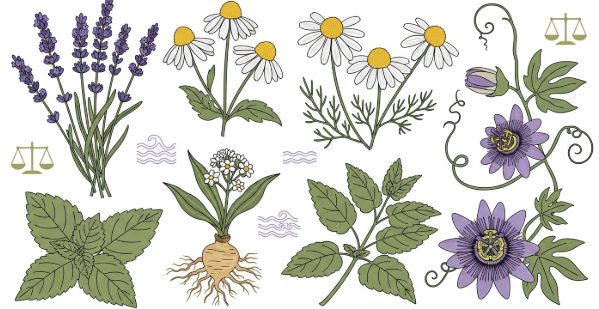
3. Passionflower (Passiflora incarnata)
Passionflower is traditionally used for nervousness and restlessness. Unlike sedatives, it may promote calm without impairing alertness.
Research highlights:
- Clinical comparisons show similar anxiety reduction to low-dose benzodiazepines, with fewer side effects.
- NIH lists passionflower for anxiety-related use.
Mechanism:
- Enhances GABA activity in the brain
- Supports relaxation and sleep onset
4. Lemon Balm (Melissa officinalis)
Lemon balm is widely used for mild anxiety and stress-induced digestive discomfort.
Evidence base:
- Human studies demonstrate improved mood and reduced anxiety scores.
- Often combined with other calming herbs.
Key properties:
- Mild anxiolytic effect
- Antioxidant activity
- Supports cognitive calm
5. Chamomile (Matricaria chamomilla)
Chamomile is one of the most accessible herbs for stress-related symptoms.
Clinical relevance:
- A study in Phytomedicine showed chamomile extract reduced generalized anxiety symptoms.
- Recognized by WHO monographs.
Actions:
- Supports relaxation
- May reduce mild anxiety
- Aids sleep quality
Comparison Table: Herbs Commonly Used for Stress
| Herb | Primary Action | Evidence Strength | Best For |
|---|---|---|---|
| Ashwagandha | Adaptogen | Strong | Chronic stress |
| Rhodiola | Anti-fatigue | Moderate–Strong | Mental exhaustion |
| Passionflower | GABA support | Moderate | Acute anxiety |
| Lemon Balm | Nervous system calm | Moderate | Mild anxiety |
| Chamomile | Sedative-relaxant | Moderate | Sleep-related stress |
Safety, Dosage, and Medical Considerations
Although herbs are natural, they are biologically active. Therefore, safety remains a priority.
General precautions:
- Avoid combining multiple herbs without guidance
- Be cautious during pregnancy or breastfeeding
- Monitor interactions with antidepressants or sedatives
The National Center for Complementary and Integrative Health (NCCIH) emphasizes consulting a healthcare professional before starting herbal supplements, especially for individuals with chronic conditions.
Integrating Herbs with Lifestyle Interventions
Herbs for stress and anxiety support work best when combined with evidence-based lifestyle strategies.
Recommended approaches:
- Cognitive behavioral therapy (CBT)
- Regular physical activity
- Mindfulness and breathing exercises
- Sleep hygiene practices
This integrative model aligns with recommendations from institutions such as the NIH and WHO.
Brief Note on Korean Ginseng
Korean ginseng (Panax ginseng) is sometimes discussed in stress research due to its adaptogenic properties. However, its primary role relates more to energy regulation than anxiety reduction. While limited evidence suggests potential stress-modulating effects, it should be considered a secondary option and used cautiously in anxiety-prone individuals.
Scientific References and Authoritative Sources
- World Health Organization (WHO) – Mental Health and Stress
- National Institutes of Health (NIH) – Herbal Supplements Database
- PubMed – Peer-reviewed clinical studies
- NCCIH – Herbal safety and interactions
These sources provide ongoing updates and high-quality evidence supporting safe herbal use.
Conclusion
In summary, herbs for stress and anxiety support offer promising complementary options when used responsibly. Evidence supports several herbs, including ashwagandha, rhodiola, passionflower, lemon balm, and chamomile, for their roles in stress modulation and emotional balance. However, they are not replacements for medical care. Instead, they should be integrated into a broader, professionally guided health strategy.
Always consult a qualified healthcare provider before initiating any herbal regimen, particularly for persistent or severe anxiety.
Related article: Ginseng for Oxidative Stress — Scientific Evidence, Mechanisms, and Safe Use Read also: Ginseng for Oxidative Stress Support: Evidence-Based Benefits, Mechanisms, and Safe Use