
How Adaptogens Work in the Body
Many people ask how adaptogens work in the body, especially as stress-related fatigue becomes more common. Adaptogens are natural substances, often herbs, that help the body maintain balance during physical, emotional, or environmental stress. However, their effects are not magical. Instead, they work through measurable biological systems that regulate stress, energy, and resilience.
To understand how adaptogens work in the body, we need to examine the stress response system, hormone signaling, and cellular energy production.
What Are Adaptogens?
Adaptogens are bioactive plant compounds that improve the body’s resistance to stress while maintaining normal physiological function.
The term was first defined in the mid-20th century by Russian scientists who established three criteria:
- The substance must be non-toxic at normal doses.
- It must increase resistance to stress.
- It must help normalize bodily functions.
Common adaptogens include:
- Korean ginseng (Panax ginseng)
- Ashwagandha (Withania somnifera)
- Rhodiola (Rhodiola rosea)
- Eleuthero (Eleutherococcus senticosus)
Among these, Korean ginseng is one of the most studied, particularly in relation to energy metabolism and cognitive performance.
The Core Mechanism: Regulation of the HPA Axis
To explain how adaptogens work in the body, we must focus on the Hypothalamic–Pituitary–Adrenal (HPA) axis.
The HPA axis controls the stress response. When you experience stress:
- The hypothalamus releases CRH.
- The pituitary gland releases ACTH.
- The adrenal glands release cortisol.
Cortisol is essential in small amounts. However, chronic elevation disrupts sleep, immunity, mood, and cognition.
Adaptogens appear to modulate this axis rather than suppress it. Research suggests they:
- Reduce excessive cortisol secretion
- Improve feedback sensitivity in stress signaling
- Support faster recovery after stress exposure
Instead of blocking stress, adaptogens help the system respond more efficiently.
Cellular Energy and Mitochondrial Support
Another key explanation for how adaptogens work in the body involves mitochondria.
Mitochondria produce ATP, the cell’s primary energy currency. Chronic stress impairs mitochondrial efficiency. Consequently, fatigue increases.
Studies on Korean ginseng indicate that ginsenosides may:
- Enhance mitochondrial ATP synthesis
- Reduce oxidative stress in cells
- Improve oxygen utilization
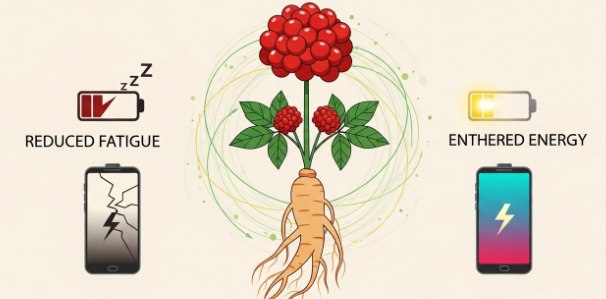
As a result, users often report improved stamina and reduced fatigue. Importantly, these effects depend on dose and extract quality.
Neurotransmitter Modulation and Brain Function
Adaptogens also influence neurotransmitters.
For example:
- Ginseng may modulate acetylcholine, which supports memory.
- Rhodiola may influence serotonin and dopamine.
- Ashwagandha may reduce anxiety by affecting GABA pathways.
Additionally, some adaptogens increase Brain-Derived Neurotrophic Factor (BDNF). BDNF supports neuronal growth and plasticity.
Therefore, when discussing how adaptogens work in the body, cognitive resilience is an important outcome. However, evidence varies by herb and study design.
Immune and Anti-Inflammatory Effects
Chronic stress increases inflammation. Elevated inflammatory cytokines contribute to fatigue and cognitive decline.
Adaptogens may:
- Regulate pro-inflammatory cytokines
- Reduce oxidative stress markers
- Support immune balance
This immunomodulatory effect further supports overall resilience.
However, these effects are not equivalent to immune stimulation. Instead, adaptogens promote balance.
Hormonal and Metabolic Regulation
Some adaptogens also influence metabolic markers.
Korean ginseng has been studied for:
- Blood glucose modulation
- Insulin sensitivity improvement
- Endothelial nitric oxide enhancement
Improved nitric oxide production supports vascular health and blood flow. Consequently, this may influence cognitive clarity and physical endurance.
Still, adaptogens should not replace medical treatment for metabolic disorders.
Evidence and Research Limitations
Although research is promising, limitations exist.
Many studies are:
- Small in scale
- Short in duration
- Variable in extract standardization
Furthermore, different preparations contain different concentrations of active compounds.
For example, standardized Korean Red Ginseng extracts may differ significantly from raw powdered root.
Therefore, clinical outcomes depend heavily on product quality.
Authoritative sources such as:
- National Institutes of Health (NIH): https://www.nih.gov
- World Health Organization (WHO): https://www.who.int
- PubMed database: https://pubmed.ncbi.nlm.nih.gov
provide research summaries and safety evaluations.
Are Adaptogens Safe?
Generally, adaptogens are well tolerated. However, side effects can occur.
Possible mild effects include:
- Headache
- Digestive discomfort
- Sleep disturbance (if taken late)
Individuals who should consult a healthcare provider include:
- Pregnant or breastfeeding women
- People with autoimmune disease
- Individuals on blood thinners
- Those taking antidepressants or diabetes medications
Professional guidance is essential before long-term supplementation.
Practical Takeaways
If you want to understand how adaptogens work in the body, remember these key principles:
- They regulate stress response systems.
- They improve cellular energy efficiency.
- They support neurochemical balance.
- They enhance resilience rather than overstimulate.
- Their effectiveness depends on extract quality and dose.
Not all adaptogens are equal. Standardized extracts with verified active compounds provide more consistent outcomes.
Final Verdict
Adaptogens work by modulating stress pathways, supporting mitochondrial energy production, and stabilizing neurochemical systems. They do not eliminate stress. Instead, they improve your ability to adapt.
Among adaptogens, Korean ginseng has some of the strongest evidence for energy, cognition, and resilience support. However, more large-scale trials are still needed.
Always consult a healthcare professional before starting supplementation, especially if you have underlying medical conditions.
Medical Disclaimer
This article is for educational purposes only and does not replace professional medical advice. Consult a qualified healthcare provider before beginning any supplement regimen.