
In an era defined by nonstop notifications, multitasking expectations, and cognitive overload, maintaining mental clarity has become a daily battle. Professionals, students, and entrepreneurs often describe the same symptoms: brain fog, trouble sustaining attention, reduced working memory, and decision fatigue by mid-day. Many turn to caffeine, but its benefits come with jitters, energy crashes, and diminishing returns.
This is where interest in ginseng for mental clarity and focus has surged. Unlike stimulants, ginseng works through deeper biological mechanisms—supporting neurotransmitters, reducing oxidative stress, improving cerebral blood flow, and promoting long-term brain resilience. Ancient medicine revered ginseng for vitality; now, modern neuroscience is examining how it enhances cognitive function in high-performance minds.
This article explores the science, mechanisms, and practical ways to integrate ginseng into a cognitive optimization plan.
⭐ Medical Disclaimer (Prominently Displayed)
This article is for educational purposes only. It is not medical advice, nor is it intended to diagnose, treat, cure, or prevent any condition. Always consult a qualified healthcare provider before starting any supplement, including ginseng, especially if you take medications, have neurological conditions, or are pregnant or breastfeeding.
The Neuroscience of Focus: What Happens When Concentration Fails?
Before understanding how ginseng works, it helps to examine what reduces mental clarity in the first place.
Cognitive Load Theory and Brain Fatigue
Your brain processes information through working memory, a limited system that can handle only a few items at once. When cognitive load exceeds capacity—due to multitasking, constant switching, or emotional stress—you experience:
- Difficulty concentrating
- Slower processing
- Reduced accuracy
- Poor short-term memory
- The “foggy,” overloaded feeling
This is cognitive fatigue—not a lack of intelligence, but a depleted neural system.
Neurotransmitters Behind Mental Clarity: Dopamine, Acetylcholine & BDNF
Dopamine drives motivation and reward-based focus.
Acetylcholine enables sustained attention, memory encoding, and mental endurance.
BDNF (Brain-Derived Neurotrophic Factor) supports neuroplasticity—your brain’s ability to adapt, form new pathways, and recover from stress.
When these systems are low, concentration falters.
📌 Authoritative Resource:
Harvard Health explains how neurotransmitters govern cognition:
https://www.health.harvard.edu/mind-and-mood/what-is-a-neurotransmitter
Ginseng’s Cognitive Toolkit: How It Works at the Cellular Level
Ginseng is classified as an adaptogen, meaning it helps the body maintain balance under stress. But its cognitive benefits come from specific brain-active molecules.
Ginsenosides: The Brain-Active Compounds
The key compounds include:
- Rb1 – supports learning and memory pathways
- Rg1 – enhances alertness, reduces fatigue
- Re – improves cerebral blood flow and neuroprotection
These compounds cross the blood-brain barrier and influence both neurotransmission and cellular resilience.
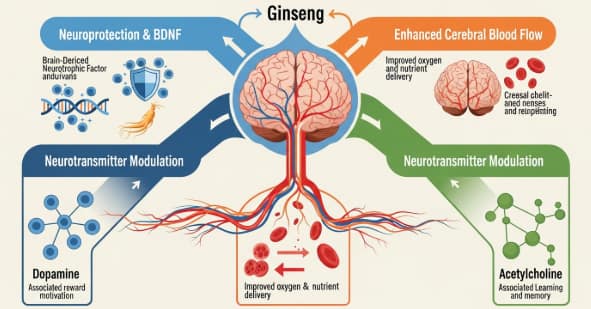
Triple-Action Mechanism: Neuroprotection + Blood Flow + Neurotransmitter Modulation
- Neuroprotection:
Ginseng reduces oxidative stress, protecting neurons. This prevents mental fatigue during long cognitive sessions. - Cerebral Blood Flow:
Increased blood flow = more oxygen + glucose (the brain’s fuel), resulting in clearer thinking. - Neurotransmitter Support:
Studies show modulation of dopamine, serotonin, and acetylcholine—chemicals essential for focus.
Clinical Evidence: What Studies Show
Human trials have found:
- Improved working memory speed
- Enhanced executive function
- Better dual-task performance
- Reduced mental fatigue
A 2010 study in the Journal of Psychopharmacology found that Panax ginseng significantly improved cognitive performance and subjective calmness.
📌 Peer-reviewed study:
https://journals.sagepub.com/home/jop
Comparative Analysis: Ginseng vs. Other Nootropics
| Compound | Benefit Style | Drawbacks | Why Ginseng Stands Out |
|---|---|---|---|
| Caffeine | Rapid alertness | Crash, jitteriness | Ginseng is smoother, sustained |
| L-Theanine | Relaxed focus | Mild effect solo | Ginseng enhances motivation & clarity |
| Bacopa Monnieri | Memory support | Takes 6–8 weeks | Ginseng offers quicker cognitive effects |
Ginseng’s advantage:
It supports cognitive clarity without overstimulation, making it ideal for long workdays and high-load mental tasks.
The Professional’s Protocol: Optimizing Ginseng for Cognitive Performance
Choosing Your Type: Korean vs. American vs. Siberian Ginseng
- Korean (Panax) Ginseng:
Best for focus, energy, and cognitive enhancement. - American Ginseng:
Supports calmness and balanced energy—ideal for stress-prone individuals. - Siberian Ginseng (Eleuthero):
Not a true ginseng, but still useful for fatigue resistance.
For mental clarity, Korean Panax ginseng offers the strongest evidence.
Delivery Matters: Extracts & Bioavailability
Look for:
- Standardized extract 3–5% ginsenosides
- Liposomal formats for improved absorption
- 100–200 mg per dose for cognitive use
Timing & Stacking Recommendations
Best taken:
- Morning (before deep work)
- Early afternoon (avoid late evening to prevent overstimulation)
Nootropic Stacks
Ginseng + Rhodiola Rosea:
Better stress resilience + clarity
Ginseng + Lion’s Mane:
Supports BDNF and neuroplasticity
Ginseng + L-Theanine + Caffeine:
Smooth energy with reduced jitteriness
Real-World Applications: Case Studies & User Scenarios
1. Creative Professional Facing a Deadline
A designer experiencing mental block used 200 mg Panax ginseng daily for two weeks. Self-reported outcomes:
- Longer deep-work sessions
- Faster idea generation
- Less fatigue during revisions
2. University Student in Exam Season
A student stacked ginseng + L-theanine. Effects:
- Improved working memory recall
- Reduced panic during timed exams
- More stable motivation
3. Corporate Executive During Intense Projects
Reported:
- Better meeting retention
- Smoother decision-making
- Reduction in afternoon brain fog
Important Considerations and Smart Usage Guidelines
Safety Profile & Potential Side Effects
Possible mild effects:
- Headache
- Digestive discomfort
- Insomnia if taken too late
- Feeling overly stimulated (rare)
Contraindications (Important)
Avoid or consult a doctor if you take:
- Blood thinners
- Anti-diabetic medication
- Stimulants
- SSRIs/SNRIs
- Immunosuppressants
📌 Drug interaction database (NIH):
https://www.cancer.gov/about-cancer/treatment/cam/patient/ginseng-pdq#link/_20
Cycling Guidelines
Use 5 days on / 2 days off or 8 weeks on / 1–2 weeks off
to maintain sensitivity and avoid tolerance.
Conclusion
In a high-pressure digital environment, maintaining sharp mental clarity is more than a luxury—it’s a necessity. Research is beginning to support what traditional medicine long understood: ginseng for mental clarity and focus offers meaningful cognitive support through neurotransmitter balance, reduced oxidative stress, and improved cerebral blood flow.
It is not a miracle cure, but a versatile, evidence-backed tool for professionals, students, and knowledge workers seeking mentally sustainable performance. Pair ginseng with quality sleep, movement, and structured deep work, and it can become a cornerstone of your mental optimization toolkit.
Frequently Asked Questions (FAQ)
1. How long before ginseng improves cognitive function?
Most users notice clearer thinking within 1–2 hours, with stronger benefits after 1–2 weeks.
2. Can ginseng replace ADHD medication?
No. It can be complementary but cannot replace clinical treatment.
3. Optimal daily dosage for mental clarity?
100–400 mg of standardized extract. Start low and assess tolerance.
4. Morning vs. evening dosing?
Morning is best. Evening may disrupt sleep.
5. Ginseng vs. caffeine for focus?
Ginseng offers smoother, more sustained clarity without the crash.
🇰🇷 Premium Korean Ginseng Online Shop


