
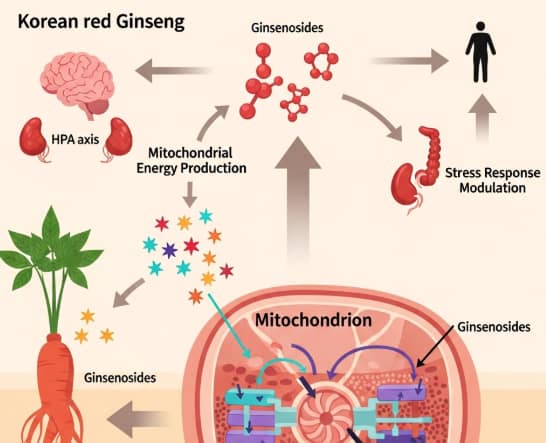
Low energy and chronic fatigue are among the most common modern health complaints, affecting people of all ages — from office workers and students to older adults and athletes.
Korean red ginseng (Panax ginseng, 홍삼 / 紅蔘) has been traditionally used in Korean and East Asian medicine as a vitality-enhancing tonic for over 2,000 years. Modern research now explores its potential role in energy production, mitochondrial function, stress adaptation, endocrine balance, and mental performance.
⚠ Disclaimer
Korean red ginseng does not cure medical fatigue conditions such as chronic fatigue syndrome, anemia, or thyroid disorders. It may provide general support for healthy energy levels but is not a substitute for proper diagnosis and treatment.
Why Do People Experience Fatigue?
Fatigue is a multifactorial condition linked to:
Physiological causes
- Sleep deprivation
- Nutrient deficiencies
- Stress hormone dysregulation
- Inflammation
- Mitochondrial dysfunction
- Blood sugar imbalance
- Sedentary lifestyle
- Post-viral fatigue
- Aging
Psychological causes
- Depression
- Anxiety
- Burnout
- Cognitive overload
Many individuals look beyond stimulants and caffeine for sustainable energy solutions, which is where adaptogens like Korean red ginseng enter the conversation.
How Korean Red Ginseng May Support Energy
1. Improves Mitochondrial ATP Production
Research suggests ginsenosides may improve oxidative phosphorylation and ATP output, the primary cellular energy molecule.
📎 source
https://www.ncbi.nlm.nih.gov/pmc/articles/PMC3659550/
https://pubmed.ncbi.nlm.nih.gov/22814660/
2. Adaptogenic Effects on Stress and Cortisol
As an adaptogen, red ginseng helps the body modulate stress response, which may reduce stress-related exhaustion.
📎 research
https://pubmed.ncbi.nlm.nih.gov/27401633/
3. Improved Cognitive Performance & Mental Energy
Fatigue is not only physical — many experience mental fatigue. Ginseng has shown potential nootropic effects including:
- Focus
- Working memory
- Reaction time
📎 clinical trials
https://pubmed.ncbi.nlm.nih.gov/12857597/
https://link.springer.com/article/10.1007/s00394-015-0903-4
4. Anti-fatigue effects in exercise & physical activity
Athletes and active individuals use Korean red ginseng for endurance and reduced exercise-induced fatigue.
📎 research
https://pubmed.ncbi.nlm.nih.gov/23454498/
Clinical Summary
| Study | Participants | Result |
|---|---|---|
| Reay et al. 2005 | 30 adults | Improved mental fatigue & reaction time |
| Lee et al. 2013 | 90 cancer patients | Reduced fatigue vs placebo |
| Song et al. 2012 | Athletes | Better endurance and reduced lactate |
Dosages in studies typically range 1,000–3,000 mg per day over 4–12 weeks.
Compare Korean Red Ginseng vs Caffeine
| Feature | Ginseng | Caffeine |
|---|---|---|
| Instant stimulation | ❌ no | ✔ yes |
| Sustainable energy | ✔ yes | ❌ no |
| Stress regulation | ✔ yes | ❌ may worsen |
| Sleep disturbance | low risk | high risk |
| Withdrawal | minimal | common |
→ Ginseng = Adaptogenic long-term support
→ Caffeine = Short-term stimulant
Best Uses of Ginseng for Energy
✔ Work productivity
✔ Study & cognitive work
✔ Recovery from stress
✔ Post-illness fatigue support
✔ Aging / vitality decline
✔ Athletes & fitness performance
Recommended Usage
🕒 Time: Morning / early afternoon
💊 Form: Extract capsule, tincture, tonic, concentrate
🏷 Dose: 1,000–3,000 mg/day (varies by extract)
How to Choose the Right Korean Red Ginseng
Look for:
- 6-year matured Korean ginseng
- Red ginseng (steamed, dried)
- Standardized ginsenoside content
- GMP-certified brand
- No filler or adulteration
- Authentic Korean origin (not American ginseng)
FAQ
Is it safe to take ginseng every day?
Yes for most people, but avoid excessive dosing. Long-term use up to 3 months is generally well tolerated.
Does ginseng cause jitters?
No — unlike caffeine, it is not a stimulant.
How long until I feel results?
Most users report improvements in 2–4 weeks of regular use.


