
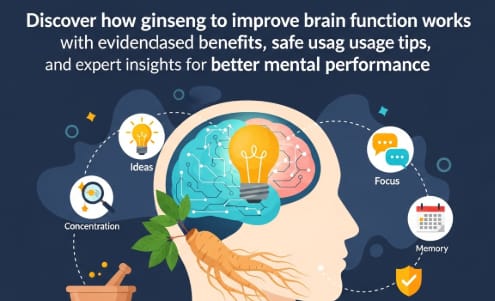
Does ginseng improve focus? This question appears more often as work becomes faster and attention spans shrink. Many people now seek natural ways to stay sharp without relying on stimulants. Among herbal options, Korean ginseng (Panax ginseng C.A. Meyer) stands out. It has centuries of traditional use and growing scientific support. However, responsible health content must separate evidence from hype. Therefore, this article reviews what research says, how ginseng works, and how to choose a safe product.
Medical disclaimer: This article is for educational purposes only. It is not a substitute for professional medical advice, diagnosis, or treatment. Always consult a qualified healthcare professional before starting any supplement.
What Is Korean Ginseng and Why Is It Studied for the Brain?
Korean ginseng refers to the root of Panax ginseng, cultivated and processed in Korea. It is often called Korean Red Ginseng when steamed and dried. The main active compounds are ginsenosides. These molecules influence neurotransmitters, inflammation, and cerebral blood flow.
Traditional East Asian medicine has used ginseng for fatigue, stress, and vitality. Today, modern research tries to explain these effects with measurable outcomes. Institutions such as the National Institutes of Health (NIH) and databases like PubMed host many studies on ginseng and cognition. For example:
- NIH Office of Dietary Supplements overview: https://ods.od.nih.gov/factsheets/Ginseng-Consumer/
- PubMed search on Panax ginseng and cognition: https://pubmed.ncbi.nlm.nih.gov/?term=Panax+ginseng+cognition
- World Health Organization monograph on ginseng: https://apps.who.int/iris/handle/10665/42011
These sources show why scientists continue to test ginseng in controlled trials.
Does Ginseng Improve Focus? What the Evidence Says
The key question remains: does ginseng improve focus in healthy adults or stressed workers? The short answer is: it may help, but results depend on dose, extract, and individual condition.
Several randomized controlled trials suggest modest benefits in:
- Attention and reaction time
- Working memory
- Mental fatigue reduction
For instance, a double-blind study published in Psychopharmacology reported improved mental arithmetic performance after standardized ginseng extract. Another trial in Journal of Ginseng Research found reduced subjective fatigue and better cognitive performance during sustained tasks.
You can explore these types of studies here:
- https://pubmed.ncbi.nlm.nih.gov/15516469/
- https://www.sciencedirect.com/journal/journal-of-ginseng-research
However, not all studies show strong effects. Some show small or task-specific improvements. Therefore, reputable reviews conclude that ginseng is not a magic pill, but it can support focus, especially under stress or fatigue.
How Ginseng May Support Focus and Mental Performance
To understand potential benefits, it helps to look at mechanisms. Research suggests several pathways:
1. Neurotransmitter Modulation
Ginsenosides can influence acetylcholine, dopamine, and serotonin systems. These neurotransmitters play roles in attention, motivation, and memory. Balanced signaling often means clearer thinking.
2. Improved Cerebral Blood Flow
Some studies show better nitric oxide–mediated vasodilation. In simple terms, this can support oxygen and glucose delivery to the brain. As a result, mental endurance may improve.
3. Anti-Fatigue and Anti-Stress Effects
Chronic stress impairs focus. Korean ginseng is classified as an adaptogen. Adaptogens help the body adapt to stress. Therefore, by lowering perceived fatigue, focus can feel more stable during long tasks.
4. Antioxidant and Neuroprotective Actions
Oxidative stress harms neurons over time. Ginseng shows antioxidant properties in laboratory and animal studies. This does not mean it prevents disease. Still, it supports a healthier neural environment.
Together, these mechanisms explain why many people report clearer focus after consistent use. Yet, responsible science demands cautious language. Benefits are supportive, not curative.
Korean Ginseng vs. Other “Focus” Supplements
Many products claim to boost concentration. It helps to compare them with ginseng:
- Caffeine: Works fast, but may cause jitters and crashes. Ginseng works slower, yet feels smoother.
- L-theanine: Calming and helpful with caffeine. It does not address fatigue as broadly as ginseng.
- Ginkgo biloba: Often studied for circulation. Evidence is mixed, especially in healthy adults.
- Rhodiola rosea: Another adaptogen. Good for fatigue, but less studied for attention tasks than Panax ginseng.
In practice, Korean ginseng sits between a stimulant and a tonic. It does not force stimulation. Instead, it supports resilience and steady performance.
Who May Benefit the Most?
Based on clinical patterns and studies, these groups often report benefits:
- Professionals with high cognitive load
- Students during exam periods
- Adults with stress-related mental fatigue
- People who want non-stimulant cognitive support
However, healthy young adults with good sleep may notice only subtle changes. Therefore, expectations should stay realistic.
Safety, Dosage, and Medical Considerations
Safety matters as much as efficacy. Reputable sources like the NIH note that ginseng is generally safe for short-term use in typical doses. Still, side effects can occur, such as:
- Headache
- Digestive upset
- Sleep disturbance (in sensitive people)
Typical Dosage Ranges
Most clinical studies use 200–400 mg per day of standardized extract, or equivalent amounts of whole root preparations. Korean Red Ginseng products often specify ginsenoside content. This standardization improves consistency.
Important Precautions
- Pregnancy and breastfeeding: Avoid unless advised by a doctor.
- Diabetes: Ginseng can affect blood sugar. Monitoring is important.
- Blood thinners or stimulants: Interactions are possible.
- Chronic illness: Always consult your clinician first.
Again, this article does not replace professional advice. It aims to support informed decisions.
How to Choose a High-Quality Korean Ginseng Product
Not all products are equal. Quality determines both safety and results. Use this checklist:
- Botanical name clearly stated: Panax ginseng C.A. Meyer
- Origin disclosed: Preferably Korea, with traceable sourcing
- Standardized extract: Look for labeled ginsenoside content
- Third-party testing: For purity and heavy metals
- Transparent labeling: No hidden blends or vague claims
Forms include capsules, powders, extracts, and traditional slices. Capsules offer convenience. Extracts offer faster absorption. Traditional forms suit those who value classic preparation.
Practical Tips to Use Ginseng for Focus
Even the best supplement works better with good habits:
- Take ginseng earlier in the day to avoid sleep issues.
- Combine it with adequate sleep and hydration.
- Use it during high-demand periods, not endlessly.
- Track how you feel over 2–4 weeks before judging results.
Consistency matters more than single doses. Also, avoid stacking many stimulants together.
Frequently Asked Questions
Does ginseng improve focus immediately?
Some people feel subtle effects within hours. However, studies suggest more consistent benefits after days or weeks of use.
Is Korean Red Ginseng better than other types?
Korean Red Ginseng has more research and standardized processing. Therefore, it is often preferred in clinical contexts.
The Bigger Picture: Evidence, Not Hype
When people ask, does ginseng improve focus, they deserve a careful answer. Evidence suggests modest, supportive benefits, especially under stress or fatigue. It does not replace sleep, nutrition, or medical care. Still, as part of a smart routine, Korean ginseng can support mental performance in a balanced way.
Major health organizations, including the NIH and WHO, recognize ginseng as a widely used medicinal plant. PubMed hosts hundreds of studies exploring its effects. This level of scientific interest adds credibility. Yet, good medicine always avoids exaggeration.
Conclusion: Choosing Wisely and Taking Action
If you feel mentally drained, distracted, or overloaded, you are not alone. Modern life taxes attention every day. Korean ginseng offers a tradition-backed and science-informed option to support focus and resilience. The key is to choose quality, use it responsibly, and keep expectations realistic.
Look for authentic Korean ginseng with clear standardization. Read labels. Consult your healthcare professional if you have medical conditions. Then, give your brain the support it deserves.
Your focus is not just about productivity. It is about clarity, confidence, and control over your day. When used wisely, Korean ginseng can become part of that foundation. If you are ready to invest in your mental performance, start with a product that respects both tradition and science—and experience the difference that quality makes.
🇰🇷 Premium Korean Ginseng Online Shop


