
Introduction
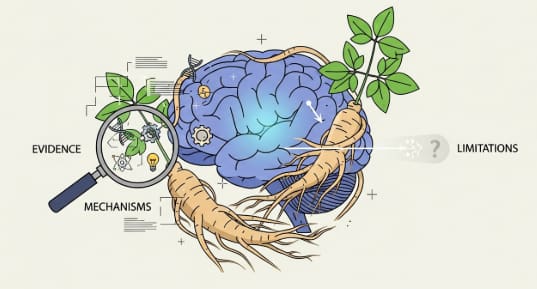
Ginseng for brain health and memory has gained attention in both traditional herbal medicine and modern research. Many people wonder whether this centuries-old remedy can truly support cognitive function. In this article, we explore the evidence, discuss possible mechanisms, and highlight current limitations — all grounded in scientific findings.
What Is Ginseng — and Why It’s Considered for Cognitive Health
Ginseng refers primarily to plants of the genus Panax ginseng (Asian ginseng) or Panax quinquefolius (American ginseng). These plants contain active compounds called ginsenosides, which are believed to affect the brain and body. Traditional medicine has long used ginseng as a “tonic” to support vitality, mental clarity, and resilience to stress.
Modern interest in ginseng for brain health and memory stems from laboratory and clinical studies that suggest possible beneficial effects on cognition, especially memory — though results remain mixed and incomplete.
What the Scientific Evidence Says About Ginseng and Memory
Meta-analyses and Reviews
A recent meta-analysis of 15 randomized controlled trials (RCTs) involving 671 participants concluded that ginseng shows a statistically significant but modest effect on memory improvement (standardized mean difference [SMD] = 0.19; 95% CI: 0.02–0.36), especially at higher doses (SMD = 0.33; 95% CI: 0.04–0.61).
PubMed
Another 2024 meta-analysis focusing on individuals with cognitive or memory impairment (e.g., mild cognitive impairment or Alzheimer’s disease) found that ginseng may positively influence certain cognitive scores, such as the Mini-Mental State Examination (MMSE) and Alzheimer’s Disease Assessment Scale-Cognitive Subscale (ADAS-Cog).
PubMed
However, an earlier comprehensive review (in 2009) concluded that evidence is insufficient to definitively state that ginseng enhances cognition in healthy individuals, because of heterogeneity in studies, small sample sizes, varied dosages, and inconsistent outcome measures.
PubMed
+1
Clinical Trials
A 6-month RCT involving 90 older adults with mild cognitive impairment (MCI) found that daily Panax ginseng powder significantly improved immediate and delayed memory recall tests compared to placebo.
PubMed
A study of healthy adults given a single dose of standardized American ginseng extract (Cereboost™) observed acute improvement in working memory tasks — notably Corsi block performance, numeric memory speed, and reaction time — as compared with placebo.
PubMed
+1
Observational Data
In a large community-based study, individuals who had used ginseng for more than five years showed better cognitive performance in late life compared to non-users. However, over a 2–4 year follow-up period, the rate of cognitive decline did not differ significantly between ginseng users and non-users.
SpringerLink
Summary: There is some supportive, but mixed and modest evidence that ginseng may benefit memory — more so in memory-impaired individuals or older adults than in healthy young adults.
How Might Ginseng Work: Proposed Biological Mechanisms
Researchers propose several plausible biological pathways by which ginseng could support brain health and memory:
Neurotransmitter modulation: Ginsenosides may influence levels of neurotransmitters such as acetylcholine, dopamine, serotonin, and glutamate. Such modulation can support synaptic communication and memory processes.
PubMed
Neuroprotection via antioxidant and anti-inflammatory action: Ginseng exhibits antioxidant properties and may reduce neuroinflammation, thereby protecting neurons from oxidative stress — a known contributor to cognitive decline.
PubMed
+1
Enhancing synaptic plasticity and memory consolidation: Experimental studies suggest that ginseng might affect signaling pathways (e.g., BDNF, CREB, mTOR) that underlie synaptic plasticity, learning, and long-term memory formation.
PubMed
Cholinergic support: By influencing acetylcholine levels and possibly reducing acetylcholinesterase activity (which breaks down acetylcholine), ginseng may support memory circuits reliant on cholinergic neurotransmission.
PMC
+1
These mechanisms are biologically plausible. However, most derive from preclinical (animal or in vitro) studies or short-term human trials. Long-term, rigorous data remain limited.
Practical Considerations: Dosage, Safety, and Who Might Benefit
If someone considers using ginseng for brain health and memory, several practical points are important:
Possible benefits might be greater for
Older adults, especially with mild cognitive impairment.
Individuals concerned about age-related memory decline.
Dosage and duration matter
Clinical trials showing memory benefit used relatively high or consistent doses over months (e.g., daily Panax ginseng for 6 months in MCI patients).
PubMed
Single-dose studies (e.g., 100–400 mg of American ginseng extract) demonstrated short-term working memory improvements.
PubMed
+1
Safety and limitations
Ginseng is generally well tolerated. Major reviews did not report serious adverse events related to cognitive-enhancement trials.
PubMed
+1
Some older reviews note that evidence remains too limited to make strong clinical recommendations.
Cochrane
+1
The effect size on memory, while statistically significant in some analyses, tends to be modest, and there is insufficient robust data for claims that ginseng can “prevent dementia” or dramatically boost cognition in healthy individuals.
Who should consult a doctor first:
People with chronic illnesses or on medications (since ginseng may interact with other drugs),
Individuals with cardiovascular issues or hormone-sensitive conditions,
Pregnant or breastfeeding women — because long-term safety data is limited.
Comparing Ginseng With Other Memory-Supporting Strategies
Strategy Evidence Strength Typical Use Case
Ginseng supplementation Mixed; modest memory benefit, stronger in older adults or impaired cognition As adjunct to overall brain health efforts or short-term memory support
Physical exercise (aerobic + strength) Strong; associated with improved memory, reduced dementia risk Long-term brain and body health
Balanced diet (e.g., Mediterranean diet) Strong; supports cognitive function and vascular health Lifelong brain support
Cognitive training / mental activity Moderate to strong; better memory & processing, especially in older adults Lifelong brain fitness
Healthy sleep, stress management Strong; poor sleep / high stress impair memory and memory-related health Everyday brain maintenance
Conclusion from comparison: While ginseng may offer some benefit, it is best considered one small component of a broader brain-health strategy.
Cautions and Why the Evidence Is Not Definitive
Study designs vary widely in terms of participant age, baseline cognition, ginseng formulations, dosages, and duration. This heterogeneity limits generalization.
Some reviews (notably from authoritative sources) conclude there is no convincing evidence yet that ginseng reliably improves cognition in healthy people.
Cochrane
+1
Many studies are short-term. Long-term safety and efficacy data, especially for healthy adults, remain sparse.
Because ginseng supplements are not strictly regulated (differences in quality, standardization, purity), results from clinical trials using standardized extracts may not apply to all commercially available products.
Thus, any use of ginseng for memory should be approached with realistic expectations.
Conclusion
There is promising but limited evidence that ginseng — particularly standardized extracts of Panax ginseng or Panax quinquefolius — may support memory, especially among older adults or those with mild cognitive impairment. Experimental and clinical data point toward possible mechanisms such as neuroprotection, neurotransmitter modulation, and enhanced synaptic plasticity.
However, the effect size tends to be modest, and results are not uniformly positive, especially in healthy younger adults. Because of study heterogeneity, limited long-term data, and variable supplement quality, ginseng cannot be considered a guaranteed “memory booster.”
If you consider trying ginseng, it’s best to:
Use a high-quality, standardized product,
Combine it with healthy lifestyle practices (balanced diet, exercise, good sleep, mental activity),
Consult a healthcare professional first — especially if you have medical conditions or take other medications.
Ginseng may offer a modest, additional layer of support — but it should not replace proven brain-healthy habits or medical treatments.
Disclaimer: This article is for informational purposes only. It is not a substitute for professional medical advice. Always consult a qualified healthcare provider before starting any supplement regimen.
Frequently Asked Questions (FAQ)
Q: Can ginseng reverse memory loss or dementia?
A: No — current evidence does not support that ginseng can reverse dementia. At best, some studies show modest improvements in memory scores for people with mild cognitive impairment or early dementia when used alongside standard treatments.
PubMed
+1
Q: How long should I take ginseng to see any memory benefits?
A: In clinical trials, benefits often appeared after several weeks to months of daily use (e.g., 6 months in a mild cognitive impairment study).
PubMed
+1
Short-term improvements (e.g., after a single dose) have also been reported, but these are typically modest and transient.
PubMed
+1
Q: Are there risks or side effects of ginseng use?
A: Ginseng is generally well tolerated. Major studies did not report serious adverse reactions in healthy individuals or those with cognitive impairment.
PubMed
+1
Still, because of limited long-term data and possible interactions, it’s best to consult a healthcare provider before use.
Q: Is Asian ginseng better than American ginseng for memory?
A: Research shows that both may have cognitive effects, but differences in ginsenoside profiles mean their effects can vary. For instance, some evidence of working memory improvement comes from American ginseng extract.
PubMed
+1
Asian ginseng also shows promise, especially for older adults or memory-impaired individuals.
PubMed
+1
Q: Should I take ginseng daily or just occasionally?
A: For potential memory support, most effective evidence comes from regular, consistent intake over weeks to months. Occasional use (e.g., a single dose) may offer short-term effects, but lasting cognitive benefits are more likely with sustained use — and only if combined with a healthy lifestyle.
🇰🇷 Premium Korean Ginseng Online Shop


