
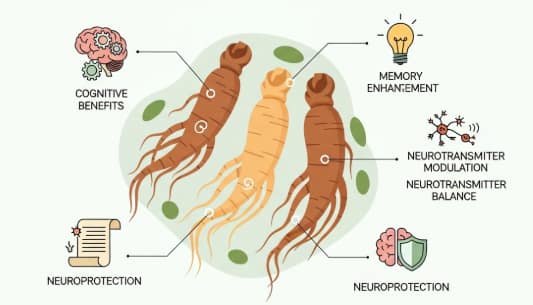
Modern life places enormous cognitive demands on the brain. Stress, poor sleep, aging, and environmental factors can contribute to mental fatigue, memory lapses, and cognitive decline. Among natural nootropics and adaptogens, Panax ginseng—particularly Korean Red Ginseng (KRG)—stands out due to its multi-layered neuroprotective effects supported by both traditional use and modern clinical research.
This article explores the mechanisms, molecular pathways, clinical evidence, recommended dosage, and safety of ginseng for enhancing cognitive function and memory.
1. Bioactive Compounds in Ginseng That Support Brain Health
Ginseng contains a complex array of bioactive molecules:
- Ginsenosides (Rb1, Rg1, Rg3, Rd, Rh2): Regulate neurotransmitters, protect neurons, and enhance synaptic plasticity.
- Polysaccharides: Modulate immune response and contribute to neuroprotection.
- Polyphenols & antioxidants: Reduce oxidative stress in the brain, which is a major contributor to cognitive decline.
- Peptides & essential oils: Support neurovascular health and protect neuronal cell membranes.
External reference:
https://www.ncbi.nlm.nih.gov/pmc/articles/PMC3659612/
These compounds collectively act on multiple pathways that govern learning, memory, focus, and attention.
2. Mechanisms of Cognitive Enhancement
2.1 Neurotransmitter Modulation
Ginseng regulates several key neurotransmitters critical for cognitive function:
- Acetylcholine: Enhances memory formation and retrieval
- Dopamine: Improves motivation, focus, and reward-driven learning
- Serotonin: Modulates mood and reduces cognitive fatigue
- GABA: Provides a calming effect that enhances cognitive clarity under stress
Study:
https://www.frontiersin.org/articles/10.3389/fphar.2017.00145/full
2.2 Synaptic Plasticity and Neurogenesis
Ginseng promotes BDNF (Brain-Derived Neurotrophic Factor) expression and facilitates long-term potentiation (LTP) in the hippocampus—essential for forming new memories and learning.
It has been shown to stimulate neuronal differentiation and dendritic growth, which improves the brain’s adaptive capacity.
Reference:
https://www.ncbi.nlm.nih.gov/pmc/articles/PMC6278355/
2.3 Antioxidant & Anti-inflammatory Actions
Cognitive decline is closely linked to oxidative stress and neuroinflammation. Ginsenosides:
- Scavenge free radicals
- Reduce lipid peroxidation in neuronal membranes
- Downregulate pro-inflammatory cytokines (TNF-α, IL-6)
- Modulate NF-κB and MAPK pathways to prevent neurodegeneration
References:
- https://www.ncbi.nlm.nih.gov/pmc/articles/PMC4940237/
- https://www.sciencedirect.com/science/article/pii/S1226845316301207
2.4 Mitochondrial Support and Energy Production
Neurons require vast amounts of energy. Ginseng enhances mitochondrial ATP production in neurons, improving:
- Cognitive stamina
- Resistance to mental fatigue
- Learning speed and focus during prolonged tasks
3. Clinical Evidence for Ginseng and Cognitive Function
3.1 Healthy Adults
- Population: Healthy adults, aged 20–60
- Intervention: 1,500 mg/day Korean Red Ginseng for 12 weeks
- Outcome: Significant improvement in working memory, attention, and cognitive processing
- Reference:
https://www.ncbi.nlm.nih.gov/pmc/articles/PMC3659558/
3.2 Mild Cognitive Impairment (MCI)
- Population: Older adults with MCI
- Intervention: KRG for 8–12 weeks
- Outcome: Improved MMSE scores, memory recall, and attention
- Reference:
https://www.ncbi.nlm.nih.gov/pmc/articles/PMC4270108/
3.3 Mental Fatigue and Cognitive Performance
Ginseng supplementation reduces mental fatigue, improves reaction time, and enhances working memory during demanding tasks.
- Study in Human Psychopharmacology
https://pubmed.ncbi.nlm.nih.gov/19322372/
4. Mechanistic Insights from Molecular Research
4.1 Neuroprotection
Ginsenosides protect neurons against glutamate-induced excitotoxicity, which is a primary cause of neurodegeneration in aging and stress-related cognitive decline.
4.2 Anti-Apoptotic Effects
Ginsenosides modulate Bcl-2 and Bax protein expression, reducing apoptosis in hippocampal neurons, thereby preserving memory function.
4.3 Enhancement of Synaptic Transmission
Ginseng improves AMPA and NMDA receptor function, which are crucial for synaptic plasticity and learning processes.
4.4 Stress Mitigation
By regulating cortisol via the HPA axis, ginseng reduces stress-induced cognitive impairment and protects memory consolidation.
5. Dosage and Administration
Effective Forms
- Korean Red Ginseng extract (capsules, liquid)
- Whole root powder
- Herbal teas or tonics
Recommended Daily Dosage
- Extract: 200–400 mg/day standardized ginsenoside
- Root powder: 1–3 grams/day
Timing: Morning or early afternoon for maximum alertness
6. Safety Profile
- Generally safe for healthy adults
- Mild side effects: insomnia (if taken late), headaches, digestive discomfort
- Avoid combining with stimulants at high doses
- Consult a doctor if pregnant, nursing, or on anticoagulants
7. Why Korean Red Ginseng is Superior for Cognitive Support
- Unique steaming and drying process enhances rare ginsenosides (Rg3, Rk1, Rh2)
- Higher bioavailability and potency compared to American or Siberian ginseng
- Clinically proven for memory, attention, neuroprotection, and stress modulation
8. Summary
Panax ginseng, particularly Korean Red Ginseng, supports cognitive function, memory, and learning through:
- Neurotransmitter modulation
- Synaptic plasticity and neurogenesis
- Antioxidant and anti-inflammatory action
- Mitochondrial energy support
- HPA axis regulation and stress mitigation
It is one of the most scientifically validated adaptogens for brain health, combining traditional wisdom with modern clinical evidence.


