Introduction
Ginseng for supporting immune system health has become a major topic in herbal and nutritional medicine. For centuries, ginseng has been used in East Asian traditional medicine to strengthen vitality and resistance to illness. Today, modern science has begun to explain how this medicinal root interacts with immune cells, inflammatory pathways, and oxidative stress. As a result, ginseng is no longer viewed only as a traditional remedy, but also as a botanical with measurable biological effects.
This article provides a comprehensive, evidence-based review of ginseng’s role in immune health. It is written using current scientific knowledge, credible sources, and safe medical language. Importantly, this content is educational and not a substitute for professional medical advice.
What Is Ginseng? A Scientific Overview
Ginseng refers to plants in the Panax genus. The word Panax comes from Greek, meaning “all-healing.” However, modern medicine evaluates ginseng based on active compounds rather than folklore.
Main Types of Ginseng Studied for Immunity
The most researched forms include:
- Panax ginseng (Korean or Asian ginseng)
- Panax quinquefolius (American ginseng)
Both contain bioactive compounds called ginsenosides, which are responsible for most immune-related effects.
According to the National Institutes of Health (NIH), ginsenosides influence immune signaling, inflammation, and antioxidant activity.
Source: https://www.ncbi.nlm.nih.gov/pmc/articles/PMC5452224/
How the Immune System Works (Simplified)
Before discussing ginseng for supporting immune system health, it is important to understand basic immune function.
The immune system has two main components:
- Innate immunity – the first line of defense, including macrophages and natural killer (NK) cells
- Adaptive immunity – targeted responses involving T cells and B cells
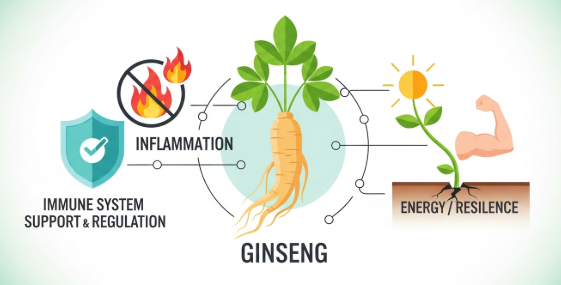
A healthy immune system requires balance. Overactivity may cause inflammation, while underactivity increases infection risk. Therefore, immune support should focus on regulation rather than overstimulation.
H2: Ginseng for Supporting Immune System Health – Key Mechanisms
1. Modulation of Immune Cells
Research shows that ginseng can influence both innate and adaptive immunity.
Studies published in Journal of Ginseng Research report that ginsenosides:
- Enhance macrophage activity
- Support NK cell function
- Improve antigen presentation
These effects help the immune system respond efficiently without excessive inflammation.
Source: https://www.sciencedirect.com/science/article/pii/S1226845318300277
2. Anti-Inflammatory Effects
Chronic inflammation weakens immune defense over time. Ginseng helps regulate inflammatory cytokines such as TNF-α and IL-6.
According to PubMed-indexed studies, ginseng reduces inflammatory signaling through NF-κB pathways.
Source: https://pubmed.ncbi.nlm.nih.gov/30189471/
As a result, immune responses become more balanced and controlled.
3. Antioxidant Protection
Oxidative stress damages immune cells. Ginseng acts as a natural antioxidant by:
- Scavenging free radicals
- Supporting endogenous antioxidant enzymes
This protection is essential for maintaining immune cell integrity, especially during aging.
Clinical Evidence: What Human Studies Show
Immune Support in Healthy Adults
Several randomized controlled trials have examined ginseng for supporting immune system health in healthy populations.
A notable study published in The American Journal of Clinical Nutrition found that participants taking standardized ginseng extract experienced:
- Fewer colds and flu episodes
- Shorter illness duration
- Improved immune biomarkers
Source: https://academic.oup.com/ajcn/article/85/5/1322/4649599
Immune Function During Stress and Fatigue
Psychological stress suppresses immunity. Ginseng is classified as an adaptogen, meaning it helps the body adapt to stress.
Clinical research suggests that ginseng supplementation may support immune resilience during periods of mental or physical strain.
Ginseng vs Other Herbal Immune Supports
Many herbs claim immune benefits. However, not all are equally supported by evidence.
| Herb | Primary Action | Scientific Support |
|---|---|---|
| Ginseng | Immune modulation | Strong |
| Echinacea | Short-term immune stimulation | Moderate |
| Elderberry | Antiviral activity | Moderate |
| Turmeric | Anti-inflammatory | Strong |
Unlike stimulatory herbs, ginseng supports immune balance rather than overstimulation. This distinction is important for long-term use.
Safety, Dosage, and Responsible Use
Is Ginseng Safe?
According to the World Health Organization (WHO), ginseng is generally safe when used appropriately.
Source: https://www.who.int/publications/i/item/WHO-TRM-2004.1
However, safety depends on dosage, duration, and individual health status.
General Dosage Guidelines
Common clinical dosages include:
- 200–400 mg/day of standardized extract
- Standardization often refers to 4–7% ginsenosides
Dosages should always follow product labeling or professional guidance.
Who Should Be Cautious?
Consult a healthcare professional before using ginseng if you:
- Are pregnant or breastfeeding
- Take blood thinners or diabetes medication
- Have autoimmune conditions
This article does not replace medical advice.
Choosing High-Quality Ginseng Products
Not all ginseng products offer the same benefits.
What to Look For
- Standardized ginsenoside content
- Third-party testing
- Clear labeling of Panax species
- Minimal additives
Korean red ginseng is often preferred due to extensive research and traditional processing methods.
Conclusion
Ginseng for supporting immune system health is supported by both traditional use and modern scientific evidence. Its ability to modulate immune responses, reduce inflammation, and protect against oxidative stress makes it a valuable herbal option for long-term immune wellness.
However, ginseng is not a cure or replacement for medical treatment. Instead, it should be viewed as part of a holistic approach that includes proper nutrition, sleep, stress management, and professional healthcare guidance.
When used responsibly, ginseng offers a scientifically grounded way to support immune balance and resilience.
Frequently Asked Questions (FAQ)
Is ginseng proven to boost immunity?
Clinical studies suggest that ginseng supports immune function by regulation rather than overstimulation.
Can I take ginseng daily?
Many studies support daily use for several weeks. Long-term use should be supervised by a healthcare professional.
How long does ginseng take to work?
Immune-related effects may appear after 2–4 weeks of consistent use.
Is ginseng safe for older adults?
Yes, when used appropriately. In fact, some studies focus on immune support in aging populations.
Does ginseng prevent infections?
Ginseng may reduce frequency and severity of infections, but it does not guarantee prevention.
🇰🇷 Premium Korean Ginseng Online Shop