
Introduction
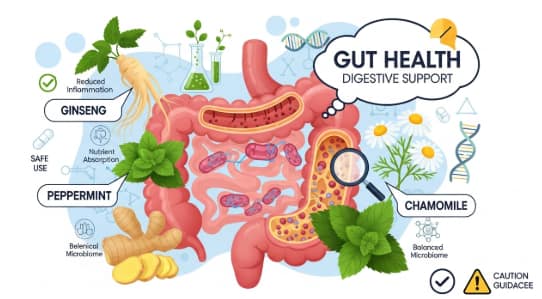
Digestive health is essential for nutrient absorption, immune regulation, and metabolic balance. When digestive function becomes compromised, the body may experience bloating, discomfort, and reduced vitality. Herbs for digestive support have been used for centuries in traditional medicine systems and are now increasingly studied through modern clinical research. When selected carefully, certain herbs may help maintain digestive comfort, support gut function, and promote overall gastrointestinal balance.
Understanding Digestive Health and Herbal Mechanisms
The digestive system includes multiple organs that work together to process food and absorb nutrients. However, stress, poor dietary patterns, medication use, and aging may impair digestive efficiency.
According to the National Center for Complementary and Integrative Health (NCCIH), several herbs have demonstrated digestive-supportive properties when used appropriately.
Source: https://www.nccih.nih.gov
Herbs for digestive support may act by:
- Supporting gastric and pancreatic enzyme activity
- Modulating gut motility
- Supporting mucosal integrity
- Influencing gut microbiota balance
Therefore, evidence-based selection is essential.
Key Herbs for Digestive Support Backed by Science
1. Ginger (Zingiber officinale)
Ginger is widely studied for digestive comfort and gastric motility. Clinical evidence suggests ginger supports stomach emptying and helps reduce occasional nausea.
Research published in Food Science & Nutrition highlights ginger’s influence on gastrointestinal function.
Source: https://pubmed.ncbi.nlm.nih.gov/30258687/
Ginger may support digestion by:
- Promoting gastric motility
- Supporting anti-inflammatory balance
- Reducing post-meal discomfort
2. Peppermint (Mentha piperita)
Peppermint oil has demonstrated smooth muscle–relaxing effects within the gastrointestinal tract.
A systematic review in BMJ supports peppermint’s role in digestive comfort for functional gastrointestinal symptoms.
Source: https://www.bmj.com/content/370/bmj.m3260
Key benefits include:
- Supporting intestinal relaxation
- Reducing gas-related discomfort
- Enhancing bile flow
3. Turmeric (Curcuma longa)
Curcumin, turmeric’s active compound, supports inflammatory balance and gut barrier integrity.
According to Nutrients, curcumin may help maintain intestinal health through multiple biological pathways.
Source: https://www.mdpi.com/2072-6643/11/9/2160
Turmeric may help:
- Support liver and bile function
- Maintain healthy inflammatory response
- Support gut lining health
4. Licorice Root (DGL – Deglycyrrhizinated Licorice)
DGL licorice is commonly used to support the stomach’s protective lining.
A study in Evidence-Based Complementary and Alternative Medicine suggests licorice supports mucosal defense mechanisms.
Source: https://www.hindawi.com/journals/ecam/2013/353262/
Benefits include:
- Supporting gastric mucosal integrity
- Reducing occasional digestive irritation
- Non-stimulating digestive support
5. Artichoke Leaf (Cynara scolymus)
Artichoke leaf extract supports bile secretion, which is essential for fat digestion.
A review in Phytomedicine highlights its role in digestive comfort and lipid metabolism.
Source: https://pubmed.ncbi.nlm.nih.gov/20382017/
Artichoke leaf may:
- Support bile flow
- Reduce post-meal fullness
- Improve digestive efficiency
Ginseng as an Advanced Herb for Digestive Support
How Ginseng Supports Digestive Function
Ginseng, particularly Panax ginseng (Korean ginseng), is traditionally known for energy and immune support. However, growing research indicates that ginseng also plays a role in digestive health and gut regulation.
According to studies indexed in PubMed, ginsenosides—the active compounds in ginseng—interact with gut microbiota and intestinal immune pathways.
Source: https://pubmed.ncbi.nlm.nih.gov/31445585/
Ginseng may support digestion through:
- Modulation of gut microbiota balance
- Supporting intestinal barrier integrity
- Influencing gastrointestinal motility
- Supporting stress-related digestive function
Ginseng and the Gut–Brain Axis
Digestive function is closely linked to the nervous system. Ginseng is classified as an adaptogenic herb, meaning it helps the body respond to stress.
Research in Journal of Ginseng Research indicates ginseng may influence the gut–brain axis by modulating stress hormones and inflammatory signaling.
Source: https://www.journals.elsevier.com/journal-of-ginseng-research
This may be relevant because chronic stress is known to impair digestion.
Ginseng’s Interaction with Gut Microbiota
Emerging research suggests that ginseng compounds are metabolized by intestinal bacteria, producing bioactive metabolites that support gut health.
A review published in Frontiers in Pharmacology highlights ginseng’s role in microbiota-mediated digestive support.
Source: https://www.frontiersin.org/articles/10.3389/fphar.2018.00739/full
Therefore, ginseng may function as a supportive herb for long-term digestive balance rather than immediate symptom relief.
How to Use Herbs for Digestive Support Safely
Although herbs are natural, they remain biologically active.
Safety guidelines include:
- Using standardized extracts
- Following recommended dosages
- Avoiding long-term unsupervised use
- Consulting healthcare professionals
The World Health Organization emphasizes quality control and safety in herbal medicine use.
Source: https://www.who.int
Herbal Digestive Support vs Conventional Approaches
| Feature | Herbal Support | Conventional Aids |
|---|---|---|
| Approach | Holistic | Symptom-focused |
| Mechanism | Multi-pathway | Single pathway |
| Use | Supportive | Acute relief |
| Safety | Requires guidance | Clinically standardized |
Herbs for digestive support work best as part of a comprehensive wellness strategy.
Lifestyle Factors That Enhance Herbal Effectiveness
Herbal benefits increase when combined with:
- Balanced nutrition
- Adequate hydration
- Stress management
- Regular eating patterns
Additionally, fermented foods may further support gut microbiota health.
Conclusion
Digestive health is complex and multifactorial. Herbs for digestive support, including ginger, peppermint, turmeric, licorice root, artichoke leaf, and ginseng, offer complementary strategies grounded in traditional use and modern scientific research. Ginseng stands out for its role in gut–brain interaction and microbiota modulation. However, herbal support should never replace medical diagnosis or treatment.
This content is for educational purposes only and is not a substitute for professional medical advice.
Frequently Asked Questions (FAQ)
Is ginseng safe for digestion?
Ginseng is generally safe when used appropriately. Medical guidance is advised.
Can ginseng help stress-related digestion?
Research suggests it may support stress response linked to digestive function.
How long do digestive herbs take to work?
Benefits are usually gradual and vary between individuals.
Can herbs replace digestive medication?
No. Herbs support digestive health but do not replace prescribed treatments.
Who should consult a doctor before using herbs?
Pregnant individuals, those with medical conditions, or medication users.
🇰🇷 Premium Korean Ginseng Online Shop


