
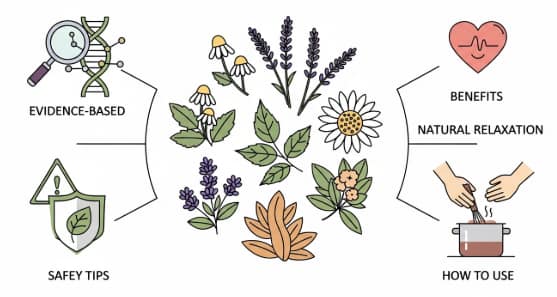
Managing stress has become essential for modern health. Many people now explore natural options to support relaxation and emotional balance. Herbs for stress relief are widely discussed, and several have emerging scientific support. In this article, we examine their potential roles, mechanisms, preparation methods, safety considerations, and what current research shows. All information is evidence-based and not a substitute for professional medical advice.
What Are Herbs for Stress Relief?
Herbal remedies for stress typically come from plants with calming or adaptogenic properties. These herbs may help the body cope with psychological or physical stressors. While they do not cure medical conditions, they may support a balanced stress response when used appropriately.
Researchers from trusted institutions such as the National Institutes of Health (NIH), World Health Organization (WHO), and studies available through PubMed have examined several herbs with potential stress-modulating effects. Although findings are promising, individual responses vary, and medical guidance is essential.
How Stress Affects the Body
Stress triggers a range of physiological reactions. Understanding this helps you make informed choices when evaluating herbs for stress relief.
When stressed, the body activates:
- The hypothalamic–pituitary–adrenal (HPA) axis, increasing cortisol
- The sympathetic nervous system, increasing heart rate
- Inflammatory pathways that may worsen chronic conditions
Long-term stress may influence mood, sleep, digestion, immunity, and cognitive performance. Therefore, many people seek supportive, natural options.
Top Evidence-Based Herbs for Stress Relief
Below are herbs studied for their potential role in stress reduction. Each has varying levels of evidence. Always consult a professional if you take medications or have health conditions.
1. Ashwagandha (Withania somnifera)
Ashwagandha is one of the most researched adaptogens. It may help the body maintain balance during stressful situations. A randomized controlled trial published in the Journal of Clinical Psychiatry reported that ashwagandha extract may reduce perceived stress scores and cortisol levels (source: https://pubmed.ncbi.nlm.nih.gov/35373400).
Benefits may include:
- Reduced perceived stress
- Improved sleep quality
- Enhanced mental performance
How to use: Capsules, powders, or standardized extracts.
2. Rhodiola rosea
Rhodiola may enhance stress resilience and support energy levels. Several human studies show reduced fatigue and improved cognitive function under stress (source: https://pubmed.ncbi.nlm.nih.gov/29325468).
Potential benefits:
- Increased mental clarity
- Reduced stress-related tiredness
- Improved focus during demanding tasks
3. Chamomile (Matricaria chamomilla)
Chamomile is widely used for relaxation. Research indicates it may support mild stress and tension (source: https://pubmed.ncbi.nlm.nih.gov/25273102).
Common uses:
- Calming tea
- Aromatherapy
- Herbal extracts
4. Lemon Balm (Melissa officinalis)
Lemon balm contains compounds that may influence GABA, a calming neurotransmitter. A study from Nutritional Neuroscience found lemon balm may support calmness and cognitive performance (https://pubmed.ncbi.nlm.nih.gov/28937802).
Possible effects:
- Mild relaxation
- Better emotional balance
- Improved sleep initiation
5. Korean Red Ginseng (Panax ginseng)
Korean ginseng may help promote vitality and stress balance. Several adaptogenic properties are documented in peer-reviewed clinical trials (https://pubmed.ncbi.nlm.nih.gov/28432050).
Potential roles:
- Supporting mental energy
- Enhancing resilience
- Balancing mood during stress
Korean red ginseng is often used across Asia as a traditional tonic to support overall well-being.
Korean Ginseng and Stress Response
Korean Red Ginseng (Panax ginseng) is one of the most extensively studied herbs for stress resilience. Its long history in traditional Asian medicine is supported by modern research that explores how its active compounds, called ginsenosides, influence the body’s stress and energy systems.
How Korean Ginseng Works in Stress Modulation
Korean ginseng interacts with multiple physiological systems that regulate stress responses.
1. HPA Axis Regulation
The hypothalamic–pituitary–adrenal (HPA) axis controls cortisol, the body’s main stress hormone.
Several clinical studies suggest that ginsenosides may help moderate the cortisol spike associated with psychological pressure. This mechanism may contribute to improved emotional balance during stressful events.
2. Enhancement of Brain Function
Research indicates that Korean ginseng may modulate neurotransmitters such as dopamine, serotonin, and GABA. Balanced neurotransmitters support improved mood, cognitive clarity, and stress resilience.
A study published in the journal Frontiers in Pharmacology found that ginseng extracts positively influenced mood stability and mental performance in adults under chronic stress (source: https://www.ncbi.nlm.nih.gov/pmc/articles/PMC6468401/).
3. Improvement of Mitochondrial Energy
Stress is deeply connected to energy depletion. Korean ginseng may support mitochondrial health, enhance ATP production, and improve overall vitality. This may explain why many individuals report better energy, focus, and stamina when taking ginseng regularly.
4. Anti-Inflammatory and Antioxidant Properties
Chronic stress often increases oxidative stress.
Ginsenosides Rg1, Rb1, and Rg3 show strong antioxidant capacity, which may help protect cells from stress-induced damage. A review in Phytotherapy Research highlights ginseng’s ability to reduce biomarkers of inflammation (source: https://pubmed.ncbi.nlm.nih.gov/29790297/).
Forms of Korean Ginseng for Stress Relief
Choosing the right form affects absorption and efficacy.
1. Red Ginseng Extract
Highly concentrated and often standardized for ginsenoside content.
2. Capsules or Tablets
Convenient for daily use and consistent dosing.
3. Ginseng Tea
Gentler and suitable for beginners, though potency is lower.
4. Liquid Tinctures
Offer faster absorption and can be adjusted drop-by-drop.
Recommended Dosage (General Guidance Only)
Always consult a healthcare professional before use.
Typical ranges in studies:
- 200–400 mg/day of standardized extract
- 1–2 g/day dried root
- Up to 2–3 g/day for experienced users
Korean ginseng may take 2–4 weeks for full benefits, especially in stress-related fatigue.
Who Benefits Most from Korean Ginseng?
Korean ginseng may be especially helpful for:
- Students or professionals under chronic mental pressure
- Individuals with low energy due to stress
- Adults seeking improved focus and cognitive stability
- People experiencing general fatigue or burnout symptoms
- Those looking for a natural adaptogen with strong clinical support
🇰🇷 Premium Korean Ginseng Online Shop


