
Introduction
How ginseng supports healthy blood sugar balance has become an important topic in nutritional science and herbal medicine. As rates of insulin resistance and type 2 diabetes continue to rise worldwide, many people are seeking evidence-based, natural strategies to support metabolic health. Ginseng, a well-researched medicinal herb used for centuries in East Asia, has gained scientific attention for its potential role in glucose regulation, insulin sensitivity, and overall metabolic balance.
This article explores the current scientific evidence behind ginseng and blood sugar regulation, explains how it works in the body, and outlines safe, practical guidance based on reputable medical sources.
Understanding Blood Sugar Balance and Metabolic Health
Blood sugar balance refers to the body’s ability to keep glucose levels within a healthy range. This process depends on several tightly regulated systems.
Key factors influencing blood sugar levels
- Insulin secretion and sensitivity
- Glucose absorption in the gut
- Liver glucose production
- Cellular glucose uptake
When these systems become impaired, blood sugar levels may rise. Over time, this imbalance increases the risk of prediabetes, type 2 diabetes, cardiovascular disease, and metabolic syndrome.
According to the World Health Organization (WHO), lifestyle interventions remain the foundation of blood sugar management. However, evidence-based herbal compounds may offer complementary support when used responsibly.
What Is Ginseng? A Brief Scientific Overview
Ginseng refers to plants from the Panax genus. The most studied varieties include:
- Panax ginseng (Korean or Asian ginseng)
- Panax quinquefolius (American ginseng)
The term Panax comes from the Greek word meaning “all-healing.” However, modern science evaluates ginseng based on its active compounds rather than tradition alone.
Active compounds in ginseng
The primary bioactive substances are ginsenosides. These compounds influence multiple metabolic pathways, including glucose metabolism, inflammation, and oxidative stress.
Research published in Journal of Ginseng Research and indexed on PubMed shows that ginsenosides interact with insulin signaling pathways and glucose transporters in cells.
How Ginseng Supports Healthy Blood Sugar Balance (Mechanisms Explained)
1. Improving insulin sensitivity
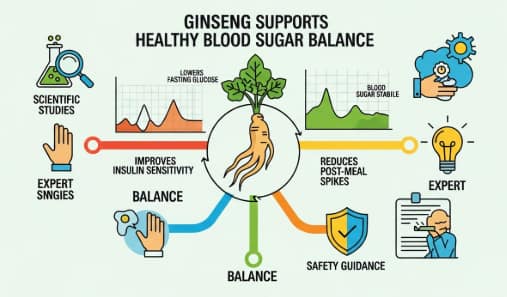
One of the most studied mechanisms behind how ginseng supports healthy blood sugar balance is its effect on insulin sensitivity. Insulin allows glucose to enter cells for energy.
Studies suggest that certain ginsenosides may:
- Enhance insulin receptor signaling
- Improve glucose uptake in muscle cells
- Reduce insulin resistance
A controlled trial published in Diabetes Care found that American ginseng modestly reduced post-meal blood glucose levels in people with type 2 diabetes.
Source: https://pubmed.ncbi.nlm.nih.gov/
2. Supporting postprandial glucose control
Postprandial blood sugar spikes occur after meals. Frequent spikes contribute to long-term metabolic damage.
Research indicates that ginseng may:
- Slow carbohydrate absorption in the intestine
- Reduce rapid glucose spikes after meals
- Support steadier glucose curves
According to the National Institutes of Health (NIH), these effects appear moderate but consistent when standardized extracts are used.
Source: https://ods.od.nih.gov/
3. Reducing oxidative stress and inflammation
Chronic inflammation and oxidative stress worsen insulin resistance. Ginseng contains antioxidant compounds that help neutralize free radicals.
Benefits may include:
- Reduced inflammatory markers
- Improved endothelial function
- Protection of pancreatic beta cells
A review in Nutrients highlights ginseng’s antioxidant role in metabolic health.
Source: https://www.mdpi.com/journal/nutrients
4. Supporting liver glucose regulation
The liver plays a central role in blood sugar control by releasing glucose between meals. Excessive hepatic glucose output raises fasting blood sugar levels.
Animal and human studies suggest that ginseng may:
- Modulate liver enzymes involved in gluconeogenesis
- Improve fasting glucose regulation
- Support healthier glycogen storage
While results are promising, researchers emphasize that ginseng works best as a complementary strategy.
Types of Ginseng and Their Blood Sugar Effects
Not all ginseng products act the same way. Understanding differences is essential for safe use.
Korean Red Ginseng
- Steamed and dried Panax ginseng
- Higher concentration of specific ginsenosides
- Most studied for metabolic support
American Ginseng
- Cooler-growing species
- Often studied for post-meal glucose control
- Generally milder stimulant effects
According to Harvard Health Publishing, both forms show potential benefits, but dosage and preparation matter.
Source: https://www.health.harvard.edu/
Safety, Dosage, and Who Should Be Cautious
Although ginseng is generally well tolerated, it is not suitable for everyone.
General safety considerations
- Typical doses range from 200–400 mg of standardized extract
- Short-term use appears safest in studies
- Effects vary based on individual metabolism
Who should consult a healthcare professional first
- People with diabetes using medication or insulin
- Pregnant or breastfeeding individuals
- Those with autoimmune or hormone-sensitive conditions
Ginseng may interact with blood sugar–lowering drugs. Therefore, medical supervision is essential.
Disclaimer: This article is for educational purposes only and is not a substitute for professional medical advice.
Comparing Ginseng With Other Herbal Approaches
Several herbs are studied for blood sugar support. However, ginseng stands out for its research depth.
| Herb | Evidence Strength | Key Benefit |
|---|---|---|
| Ginseng | Strong | Insulin sensitivity |
| Cinnamon | Moderate | Reduced fasting glucose |
| Berberine | Strong | AMPK activation |
| Bitter melon | Limited | Glucose uptake |
Unlike single-pathway herbs, ginseng works through multiple metabolic mechanisms.
Practical Tips for Using Ginseng Responsibly
To maximize benefits while minimizing risks:
- Choose standardized extracts with labeled ginsenoside content
- Avoid exaggerated “miracle cure” claims
- Combine with balanced nutrition and physical activity
- Monitor blood sugar levels regularly
Understanding how ginseng supports healthy blood sugar balance requires realistic expectations. It supports metabolic health but does not replace medical treatment.
Conclusion
Scientific evidence suggests that ginseng may play a supportive role in metabolic health through improved insulin sensitivity, antioxidant effects, and post-meal glucose control. When used responsibly, it may complement lifestyle and medical strategies for maintaining stable blood sugar levels.
However, individual responses vary. For this reason, guidance from a qualified healthcare professional remains essential. Evidence-based herbal medicine works best when integrated thoughtfully, not used in isolation.
Frequently Asked Questions (FAQ)
Can ginseng cure diabetes?
No. Ginseng does not cure diabetes. It may support blood sugar management as a complementary approach.
How long does ginseng take to affect blood sugar?
Studies suggest effects may appear within weeks. However, results vary by individual and dosage.
Is ginseng safe for long-term use?
Long-term safety data are limited. Periodic breaks and medical supervision are advised.
Can ginseng replace medication?
No. Ginseng should never replace prescribed diabetes medication.
Which ginseng is best for blood sugar balance?
Both Korean and American ginseng show benefits. Standardized extracts are preferred.
🇰🇷 Premium Korean Ginseng Online Shop


