
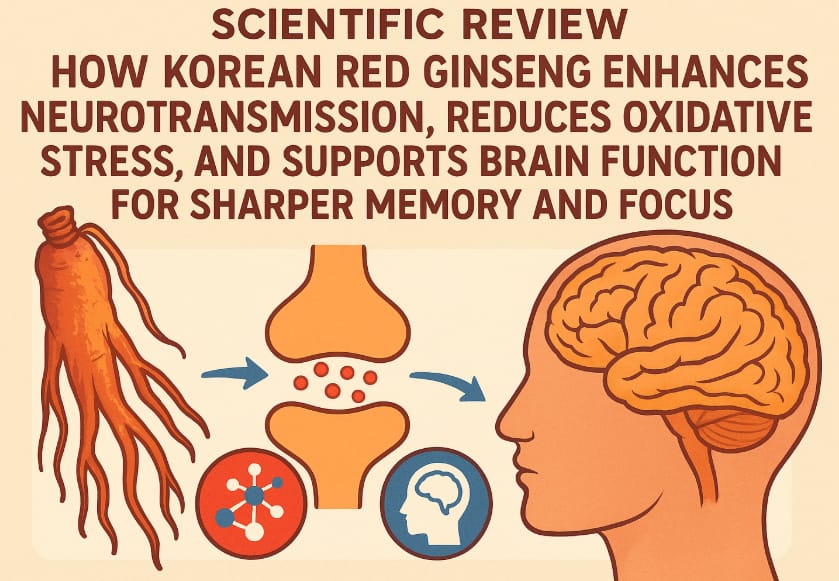
For thousands of years, Korean Red Ginseng (Panax ginseng C.A. Meyer) has been celebrated as a “mind and body tonic” in traditional Korean medicine. Ancient scholars and physicians consumed it to improve mental clarity, stamina, and longevity.
In modern times, neuroscience and clinical pharmacology have begun to confirm what ancient wisdom long suggested:
Korean Red Ginseng possesses nootropic (brain-enhancing) properties that can boost memory, cognitive performance, and concentration — especially under stress, fatigue, or aging.
This comprehensive article explores how Korean Red Ginseng supports the brain, the biochemical mechanisms behind its neuroprotective effects, and the clinical studies proving its efficacy in improving mental performance.
1. The Brain-Boosting Legacy of Korean Red Ginseng
Korean Red Ginseng differs from ordinary ginseng because it undergoes a precise steaming and drying process, converting the natural ginsenosides into more active forms such as Rg3, Rg5, and Rh2.
These bioactive compounds are known to cross the blood-brain barrier, allowing them to influence neural pathways involved in memory formation, neurotransmission, and stress response regulation.
In traditional usage, ginseng was prescribed to:
- Enhance mental clarity and learning ability.
- Reduce fatigue and improve focus.
- Combat forgetfulness in the elderly.
Modern research now provides measurable evidence for these effects.
2. Understanding the Neuroactive Compounds
The primary bioactive molecules in red ginseng include:
| Compound | Primary Action | Brain Benefit |
|---|---|---|
| Ginsenoside Rb1 | Modulates acetylcholine & dopamine | Enhances learning and memory |
| Ginsenoside Rg1 | Neurotrophic, antioxidant | Boosts focus and alertness |
| Ginsenoside Rg3 | Anti-fatigue, improves blood flow | Increases oxygen to the brain |
| Compound K | Anti-inflammatory, gut–brain modulator | Reduces neuroinflammation |
| Polysaccharides | Immunomodulatory | Supports mental resilience and recovery |
Together, these compounds act synergistically to support neuronal health and communication.
3. Mechanisms of Action: How Korean Red Ginseng Supports the Brain
🔹 1. Enhancing Neurotransmission
Ginsenosides such as Rb1 and Rg1 modulate acetylcholine (ACh) levels, a neurotransmitter essential for memory encoding and retrieval.
They also increase dopamine and serotonin levels in the prefrontal cortex—key chemicals involved in attention, motivation, and mood regulation.
📖 Reference: Kennedy et al., Human Psychopharmacology (2001) demonstrated that ginseng extract improved working memory and accuracy in attention tasks after a single dose.
🔹 2. Improving Cerebral Blood Flow and Oxygenation
Korean Red Ginseng promotes nitric oxide (NO) synthesis, leading to improved vasodilation and cerebral perfusion.
Enhanced blood flow delivers more oxygen and glucose to the brain, vital for mental stamina and concentration.
📖 Source: Kim et al., Phytotherapy Research (2010) found that red ginseng extract increased cerebral blood flow velocity by 14% in middle-aged adults.
🔹 3. Neuroprotection Against Oxidative Stress
Chronic stress and aging lead to oxidative damage in brain cells.
Ginsenosides act as antioxidant shields, neutralizing free radicals and activating the body’s internal defense systems (Nrf2 pathway).
📖 Evidence: Antioxidants (2020) reported that Rg1 and Rb1 protect hippocampal neurons and prevent cognitive decline in aged animal models.
🔹 4. Reducing Neuroinflammation
Inflammation in the central nervous system contributes to neurodegenerative disorders like Alzheimer’s and Parkinson’s disease.
Compound K—a metabolite formed during fermentation—suppresses inflammatory cytokines (IL-1β, TNF-α) and prevents microglial overactivation.
📖 Journal of Ginseng Research (2019): Fermented red ginseng significantly decreased neuroinflammation markers in diabetic mice, improving memory performance.
🔹 5. Balancing the HPA Axis and Stress Hormones
As an adaptogen, Korean Red Ginseng stabilizes the hypothalamic-pituitary-adrenal (HPA) axis, which regulates cortisol release.
By reducing cortisol spikes, ginseng helps maintain calm focus and mental endurance under stress.
📖 Nutrients (2018) showed that participants consuming Korean Red Ginseng extract reported lower fatigue and improved mood under work-related stress.
4. Cognitive Benefits Supported by Human Clinical Studies
🧠 Memory and Learning
- Kennedy et al., 2001 (Human Psychopharmacology):
Single doses of 200–400 mg red ginseng improved short-term memory and accuracy. - Lee et al., 2008 (J Altern Complement Med):
Elderly subjects taking 3 g/day red ginseng for 12 weeks showed improved memory recall and attention span.
⚡ Mental Energy and Focus
- Reay et al., 2005:
Demonstrated that red ginseng extract improved reaction time and mental arithmetic performance. - Cho et al., 2012:
Reported reduced fatigue and enhanced concentration in individuals under chronic work stress.
🧩 Cognitive Protection and Aging
- Ong et al., 2015 (Front Aging Neurosci):
Red ginseng improved memory scores in mild cognitive impairment (MCI) patients. - Park et al., 2020 (J Ginseng Res):
Found that long-term red ginseng consumption reduced risk of dementia progression.
😌 Mood and Stress Resilience
- Ginseng regulates monoamine neurotransmitters (dopamine, serotonin), reducing mental fatigue and anxiety.
- Clinical studies link regular intake to better mood stability and reduced burnout symptoms.
📖 Source: Nutrients (2019) — Participants reported higher “calmness” and “mental clarity” scores after 8 weeks of red ginseng supplementation.
5. Fermented Red Ginseng: Next-Level Brain Support
Fermented Korean Red Ginseng transforms ginsenosides into smaller, more absorbable molecules such as Compound K, which cross the blood-brain barrier more efficiently.
Benefits include:
- Enhanced memory retention and recall speed.
- Reduced inflammation in hippocampal neurons.
- Improved mitochondrial energy production in brain cells.
📖 Frontiers in Pharmacology (2019) confirmed that fermented ginseng extract significantly enhanced memory and reduced neuronal inflammation compared to non-fermented forms.
6. Combining Red Ginseng with Modern Lifestyles
For professionals, students, and older adults alike, cognitive challenges are part of everyday life—long hours, information overload, and digital distractions.
Regular supplementation of Korean Red Ginseng can help:
- Maintain focus during extended work or study sessions.
- Support neuroplasticity and mental clarity.
- Delay age-related memory loss.
Optimal Dosage:
- Extract: 200–400 mg/day
- Fermented: 100–200 mg/day
- Capsule/Tablet: Standardized to 4–6% ginsenosides
Best Time: Morning or midday for energy and alertness. Avoid at night due to mild stimulating effect.
7. Synergistic Pairings for Brain Health
To maximize ginseng’s cognitive potential, combine it with:
| Nutrient/Herb | Synergy |
|---|---|
| Omega-3 (DHA/EPA) | Enhances neuron membrane function |
| B Vitamins (B6, B12, Folate) | Supports neurotransmitter synthesis |
| L-Theanine (Green Tea) | Promotes calm focus |
| Lion’s Mane Mushroom | Stimulates nerve growth factor (NGF) |
| Magnesium L-threonate | Enhances memory and synaptic plasticity |
Such combinations can amplify both short-term alertness and long-term neuroprotection.
8. Safety, Side Effects, and Considerations
Korean Red Ginseng is considered safe when taken at recommended doses.
Mild side effects (rare):
- Insomnia (if taken too late)
- Slight jitteriness in caffeine-sensitive individuals
Contraindications:
- Individuals on anticoagulants or MAOI antidepressants should consult a healthcare provider.
Note: Ginseng is not a stimulant like caffeine—it works by optimizing energy metabolism and reducing oxidative stress, promoting sustainable mental endurance.
9. Cognitive Longevity: A Future of Neuroprotection
Emerging research suggests that Korean Red Ginseng may play a preventive role in neurodegenerative diseases.
Animal and human studies indicate it:
- Reduces β-amyloid plaque accumulation (Alzheimer’s biomarker).
- Enhances synaptic density in the hippocampus.
- Promotes neurogenesis via increased Brain-Derived Neurotrophic Factor (BDNF).
📖 Neuroscience Letters (2020) found that long-term red ginseng intake improved learning behavior and reduced brain oxidative damage in aging models.
These findings highlight Korean Red Ginseng as both a natural cognitive enhancer and a neuroprotective ally for long-term mental health.
10. Conclusion
Korean Red Ginseng stands as one of the few natural herbs with extensive scientific validation for cognitive enhancement.
Its multi-pathway mechanisms—neurotransmitter regulation, antioxidant defense, improved circulation, and adaptogenic stress balance—make it a cornerstone of holistic brain wellness.
Whether you seek sharper focus, better memory, or long-term cognitive resilience, consistent use of high-quality Korean Red Ginseng provides measurable benefits backed by tradition and modern neuroscience.
🇰🇷 Premium Korean Ginseng Online Shop


