
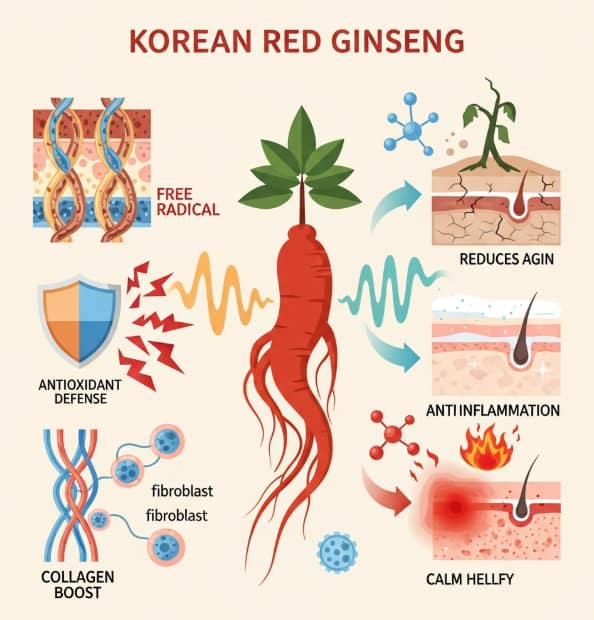
For centuries, the glowing, youthful complexion of Korean culture has been attributed not only to meticulous skincare routines — but also to a deep integration of herbal adaptogens, especially Korean Red Ginseng (Panax ginseng C.A. Meyer).
Today, modern dermatology confirms what traditional Korean medicine (Hanbang) has long understood:
🌿 Healthy, resilient skin begins at the cellular level — where inflammation, oxidative stress, and hormonal balance converge.
Korean Red Ginseng stands at the forefront of this intersection. Rich in bioactive ginsenosides, antioxidants, and polysaccharides, it influences both intrinsic aging (genetic and hormonal) and extrinsic aging (UV, pollution, and stress-induced damage).
1. The Biological Basis of Skin Aging
Skin aging is driven by two major mechanisms:
- Intrinsic aging – the natural, genetic decline of collagen synthesis, cellular turnover, and antioxidant defense.
- Extrinsic aging – external assaults such as UV radiation, air pollution, smoking, and stress-induced inflammation.
These mechanisms converge on three biochemical pathways:
- Oxidative stress (ROS accumulation)
- Inflammatory signaling (NF-κB activation)
- Matrix degradation (MMP overexpression)
As these pathways accelerate, collagen breaks down, elastin fibers stiffen, and the skin barrier weakens — leading to wrinkles, sagging, dullness, and sensitivity.
Korean Red Ginseng counters these processes at multiple molecular levels.
2. Active Compounds Behind the Glow: Ginsenosides and Beyond
Korean Red Ginseng’s skin-protective power arises from more than 40 ginsenosides, each acting synergistically on different biological systems:
| Compound | Function | Skin Benefit |
|---|---|---|
| Ginsenoside Rg1 | Stimulates fibroblast proliferation | Increases collagen & elasticity |
| Ginsenoside Rb1 | Antioxidant & anti-inflammatory | Reduces wrinkle formation |
| Ginsenoside Rg3 | Inhibits MMP-1 and UV-induced apoptosis | Prevents photoaging |
| Compound K | Enhances barrier lipids and hydration | Strengthens skin barrier |
| Polysaccharides | Immune modulation | Protects against environmental stressors |
📖 Reference: Kim et al., Journal of Ginseng Research (2020) reported that ginsenosides Rg3 and Rb1 significantly upregulated collagen gene expression while downregulating inflammatory cytokines in UVB-exposed fibroblasts.
3. Korean Red Ginseng as a Cellular Antioxidant
Every day, skin cells are bombarded by reactive oxygen species (ROS) — unstable molecules that damage DNA, proteins, and lipids.
Red ginseng combats this through dual antioxidant pathways:
- Direct scavenging: Ginsenosides neutralize ROS radicals such as superoxide and hydroxyl ions.
- Indirect activation: Stimulates the body’s own antioxidant enzymes — SOD, catalase, and glutathione peroxidase.
📖 J Ethnopharmacol (2018) found that topical red ginseng extract reduced oxidative stress markers by 52% and prevented UV-induced skin apoptosis.
This ROS buffering effect preserves fibroblast integrity, maintaining collagen matrix density and delaying wrinkle onset.
4. Anti-Inflammatory Mechanisms: Calming the “Inflammaging” Process
Inflammaging is a term describing low-grade chronic inflammation that accelerates skin aging.
When inflammatory mediators like TNF-α and IL-6 stay elevated, they trigger collagen degradation, barrier dysfunction, and pigmentation disorders.
Red Ginseng inhibits these pathways by:
- Blocking NF-κB and AP-1 transcription factors
- Reducing expression of COX-2 and iNOS
- Modulating cytokine balance between pro- and anti-inflammatory signals
📖 Phytotherapy Research (2019) showed that ginsenoside Rg3 reduced UVB-induced erythema and edema by suppressing inflammatory gene expression.
As a result, skin retains calmness, clarity, and even tone, even under environmental or hormonal stress.
5. Collagen Synthesis and Elastin Protection
Youthful skin depends on the dynamic renewal of the extracellular matrix (ECM).
However, with age and UV exposure, Matrix Metalloproteinases (MMP-1, MMP-3) degrade collagen faster than it is produced.
Red Ginseng’s bioactive compounds counter this imbalance:
- Inhibit MMP activity to prevent collagen loss
- Upregulate TGF-β and procollagen gene expression
- Protect fibroblasts from UV-induced apoptosis
📖 Dermato-Endocrinology (2017) found that red ginseng extract restored 35% of collagen density in aged murine models and visibly reduced wrinkle depth after 8 weeks of topical application.
6. Skin Barrier Strength and Hydration
A robust skin barrier prevents trans-epidermal water loss (TEWL) and protects against irritants and microbes.
Red Ginseng enhances barrier integrity by:
- Boosting ceramide and lipid synthesis
- Promoting filaggrin expression (key for hydration)
- Supporting tight junction proteins that seal the epidermis
📖 Nutrients (2020) documented that fermented red ginseng extract increased skin hydration by 36% and decreased TEWL by 22% after 4 weeks.
These improvements translate to plumper, smoother, and more radiant skin.
7. Whitening and Pigmentation Control
Hyperpigmentation results from excess melanin synthesis triggered by UV light, inflammation, or hormonal shifts.
Ginsenosides and red ginseng polysaccharides modulate melanin production by:
- Inhibiting tyrosinase, the key enzyme in melanin synthesis
- Downregulating MITF gene expression
- Promoting even melanosome distribution
📖 Int J Mol Sci (2019): Ginsenoside Rb1 reduced melanin content by 43% in melanocytes without cytotoxicity — offering a safer natural brightening effect compared to synthetic agents like hydroquinone.
8. Hormonal and Stress-Related Skin Aging
Chronic psychological stress elevates cortisol, which impairs skin barrier recovery and increases inflammation.
Meanwhile, hormonal decline (especially estrogen in women) accelerates collagen loss and dryness.
Korean Red Ginseng acts as a phytoadaptogen, balancing these pathways through:
- Cortisol regulation (via HPA axis modulation)
- Estrogen receptor activation (ER-β) — improving elasticity and hydration
- Androgen modulation — helping control sebum and acne in stressed skin
📖 Menopause (2016) observed that postmenopausal women taking 2 g/day of red ginseng showed significant improvements in skin elasticity, hydration, and overall facial glow.
9. Clinical and Cosmetic Applications
✨ Topical Formulations
- Creams and serums with 1–3% red ginseng extract improve fine lines and barrier repair.
- Fermented ginseng essence enhances penetration and microbiome balance.
💊 Oral Nutricosmetics
- Ginseng capsules or tonics deliver antioxidants and hormonal support from within, showing measurable skin elasticity improvements after 8–12 weeks.
📖 Clin Cosmet Investig Dermatol (2021) reported that oral and topical ginseng combined produced synergistic anti-wrinkle effects greater than either route alone.
10. Microbiome and Skin Immunity
Recent research links skin health to its microbiome ecosystem.
Fermented red ginseng acts as a prebiotic, promoting beneficial bacterial balance both in the gut and on the skin surface.
This balance reduces inflammatory flare-ups (acne, dermatitis) and enhances skin resilience against pollutants.
📖 Front Microbiol (2022) confirmed that ginsenoside fermentation increased probiotic growth (Lactobacillus plantarum), improving barrier recovery and reducing redness.
11. Safety and Dermatological Compatibility
Korean Red Ginseng is hypoallergenic, non-comedogenic, and compatible with most skin types.
It suits:
- Sensitive skin (anti-inflammatory, barrier-repairing)
- Mature skin (collagen-boosting)
- Dull or uneven skin (brightening and energizing)
Adverse reactions are rare and typically related to excessive internal intake (mild insomnia or sensitivity in caffeine users).
12. Summary Table: Dermatological Benefits of Korean Red Ginseng
| Function | Mechanism | Visible Benefit |
|---|---|---|
| Anti-aging | Stimulates collagen & elastin | Fewer wrinkles, firmer skin |
| Anti-inflammatory | Inhibits NF-κB and cytokines | Reduced redness & sensitivity |
| Antioxidant | Scavenges ROS, boosts SOD | Brighter, even tone |
| Barrier repair | Increases ceramide & filaggrin | Hydrated, resilient skin |
| Whitening | Inhibits tyrosinase & MITF | Reduced dark spots |
| Hormonal balance | Modulates cortisol & estrogen | Improved elasticity & glow |
13. Conclusion
Korean Red Ginseng is not just a medicinal root — it is a dermatological adaptogen that rejuvenates skin from the cellular core.
By addressing oxidative stress, inflammation, collagen degradation, and hormonal imbalance, it slows the biological clock and restores a youthful, radiant complexion.
Whether applied topically or taken internally, the synergy of ginsenosides provides holistic anti-aging effects, uniting the wisdom of Korean herbal medicine with cutting-edge cosmetic science.
As a result, Korean Red Ginseng remains a timeless secret to skin longevity, calmness, and vitality.
🇰🇷 Premium Korean Ginseng Online Shop


