
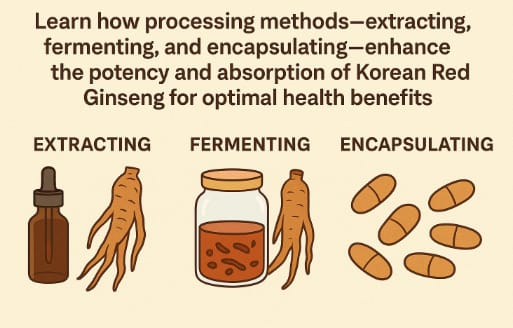
For centuries, Korean Red Ginseng (Panax ginseng C.A. Meyer) has been regarded as one of the most valuable medicinal plants in Asia. Traditionally consumed to promote vitality, stamina, and longevity, this powerful adaptogen is now widely used in multiple processed forms—from concentrated extracts to modern fermented supplements.
Yet many people still wonder: Does the form of ginseng really matter?
Modern pharmacological research shows that processing methods dramatically influence the concentration, absorption, and bioactivity of ginseng’s active compounds—called ginsenosides.
In this in-depth article, we’ll explore the science behind various forms of Korean Red Ginseng, compare their health benefits, and explain how processing enhances its medicinal potential for energy, immunity, metabolism, and cognitive health.
1. The Science Behind Korean Red Ginseng
Korean Red Ginseng is not just “dried ginseng.” It is produced through a unique steaming and drying process that distinguishes it from white or fresh ginseng.
This transformation converts delicate raw ginsenosides into more potent derivatives—especially Rg3, Rg5, and Rh2—which exhibit higher antioxidant, anti-inflammatory, and anti-fatigue activities.
Key Active Compounds
- Ginsenosides (Rb1, Rg1, Rg3, Re, Rh1, Rh2, Compound K) — regulate energy metabolism, immunity, and glucose balance.
- Polysaccharides — support immune modulation and gut microbiota balance.
- Polyacetylenes & peptides — contribute to neuroprotection and anti-aging effects.
Each processing form alters how these compounds are preserved, converted, or absorbed in the body.
2. Traditional vs. Modern Processing Methods
🔹 White Ginseng
- Produced by air-drying fresh roots without steaming.
- Contains original ginsenosides (Rb1, Rg1, Re) but lacks thermally converted metabolites.
- Gentler and less stimulating; suited for general vitality and mild fatigue.
🔹 Red Ginseng
- Steamed at 95–100°C for 2–3 hours, then dried.
- Converts polar ginsenosides into more bioactive, less sugar-bound forms like Rg3 and Rh2.
- Demonstrates stronger antioxidant, anti-inflammatory, and adaptogenic effects.
🔹 Fermented Red Ginseng
- Subjected to enzymatic or microbial fermentation using beneficial bacteria (e.g., Lactobacillus plantarum).
- Transforms large ginsenosides into smaller, readily absorbable metabolites such as Compound K, which exhibits superior bioavailability.
- Shows amplified effects on insulin sensitivity, cognitive function, and gut health.
3. Main Processed Forms of Korean Red Ginseng and Their Benefits
🔸 A. Red Ginseng Extract (Concentrate)
Overview:
The most potent and popular form, made by boiling ginseng roots in water and evaporating the solution into a thick, dark syrup rich in ginsenosides.
Benefits:
- Rapid absorption and high concentration of active compounds.
- Clinically proven to enhance energy, immunity, and cognitive function.
- Shown to reduce fatigue and support blood sugar balance.
Scientific Evidence:
A 2018 study published in Nutrients found that subjects who consumed 2000 mg of Korean Red Ginseng extract daily for 8 weeks experienced a significant increase in mental alertness and a 20% reduction in fatigue scores compared to placebo.
Ideal For:
- Individuals seeking a concentrated daily tonic.
- Those combating fatigue, brain fog, or immune weakness.
🔸 B. Red Ginseng Powder (Raw or Freeze-Dried)
Overview:
Made from ground dried red ginseng roots. Preserves the full phytochemical matrix, including fibers and polysaccharides.
Benefits:
- Provides balanced stimulation without spikes in energy.
- Supports digestion, vitality, and long-term resilience.
- Excellent as a tea or smoothie additive.
Scientific Insight:
Raw ginseng powder demonstrates a sustained-release effect, providing slower but longer-lasting increases in blood ginsenoside levels, according to Journal of Ginseng Research (2016).
Ideal For:
- Daily wellness maintenance.
- Those preferring natural, unprocessed intake.
🔸 C. Red Ginseng Capsules and Tablets
Overview:
Modern supplements that offer convenience and precise dosing. Typically standardized to contain 4–7% total ginsenosides.
Benefits:
- Reliable and consistent potency.
- Easy to integrate into daily routines.
- Shown to improve insulin sensitivity, immune balance, and focus.
Clinical Reference:
In Phytomedicine (2013), 12 weeks of standardized red ginseng capsule intake led to significant improvements in insulin sensitivity and post-meal blood sugar levels among prediabetic adults.
Ideal For:
- Busy professionals or those seeking simple daily supplementation.
🔸 D. Fermented Red Ginseng
Overview:
Processed through microbial fermentation to increase the proportion of Compound K—a metabolite with superior absorption and biological activity.
Benefits:
- 3–5× higher bioavailability compared to non-fermented extracts.
- Strong effects on metabolic health, inflammation, and immune function.
- Supports gut microbiota and nutrient absorption.
Scientific Evidence:
A Frontiers in Pharmacology (2019) study found that fermented red ginseng improved insulin resistance and reduced inflammatory cytokines in diabetic mice more effectively than non-fermented forms.
Ideal For:
- People managing metabolic syndrome, diabetes, or chronic inflammation.
- Those with sensitive digestion or low nutrient absorption.
🔸 E. Ginseng Tonic Drinks and Functional Beverages
Overview:
Liquid formulations that combine red ginseng extract with vitamins, royal jelly, or herbal adaptogens.
Benefits:
- Quick absorption and refreshing energy boost.
- Ideal for fatigue, stress, or post-workout recovery.
- Provides hydration and instant revitalization.
Note:
While convenient, tonics may contain added sugars—so choose low-sugar, high-ginsenoside variants for best results.
4. Bioavailability: Why Fermentation Matters
Ginsenosides in raw ginseng are poorly absorbed because of their large molecular structure. The intestinal microbiota must metabolize them into smaller derivatives, mainly Compound K, before they can enter systemic circulation.
Fermentation pre-digests these molecules, making them ready for absorption.
- Absorption rate: 10× higher for compound K-rich extracts.
- Time to peak plasma concentration: reduced from 12 hours (raw) to 4 hours (fermented).
This explains why fermented Korean Red Ginseng often produces faster and stronger effects on blood sugar, fatigue, and cognitive performance.
5. Comparative Summary: Forms and Health Focus
| Form | Bioavailability | Key Ginsenosides | Best For | Primary Benefits |
|---|---|---|---|---|
| Extract (Concentrate) | High | Rb1, Rg1, Rg3 | Daily energy, focus | Energy, stamina, cognition |
| Powder | Moderate | Rb1, Re, Rf | Long-term vitality | Immune support, digestion |
| Capsules | Standardized | Rb1, Rg1 | General supplementation | Metabolism, endurance |
| Fermented | Very high | Compound K, Rg3 | Metabolic, immune health | Blood sugar, inflammation |
| Tonic Drink | Rapid | Mixed | Quick energy boost | Fatigue, hydration |
6. Clinical Benefits Across All Forms
Regardless of processing, Red Ginseng demonstrates consistent benefits in major health domains:
🔹 Metabolic Health
Enhances insulin sensitivity, stabilizes blood glucose, and reduces triglycerides.
Supported by: Phytomedicine (2013), Nutrients (2018), J Ginseng Res (2020)
🔹 Immune Modulation
Increases T-cell and natural killer cell activity, fortifying the body against infections.
Source: Nutrients (2012), Front Immunol (2021)
🔹 Energy and Fatigue
Stimulates mitochondrial ATP production, improving endurance and physical resilience.
Source: J Ethnopharmacol (2016)
🔹 Cognitive Function
Protects neurons, boosts neurotransmitter levels, and supports memory retention.
Source: Human Psychopharmacology (2019)
🔹 Anti-Aging and Skin Health
Reduces oxidative stress and enhances collagen synthesis.
Source: Antioxidants (2020)
7. Safety and Usage Recommendations
Korean Red Ginseng is well tolerated by most adults. Typical dosage ranges:
- Extract or Capsule: 200–400 mg/day
- Fermented Form: 100–200 mg/day (due to higher potency)
- Powder or Tea: 1–2 g/day
⚠️ Avoid excessive intake (>2 g/day extract) to prevent insomnia or overstimulation.
Consult a healthcare provider if taking antidiabetic, anticoagulant, or antidepressant medication.
8. Selecting High-Quality Products
When choosing Korean Red Ginseng products, ensure they meet the following standards:
- ✅ 6-year-old roots (highest ginsenoside content)
- ✅ Standardized ginsenoside concentration (≥4%)
- ✅ Korea Ginseng Corporation (KGC) or GMP certification
- ✅ Minimal additives, no synthetic caffeine or coloring
Authentic red ginseng retains its earthy aroma, slightly bitter taste, and deep reddish-brown hue—indicators of traditional steaming.
9. Integrating Red Ginseng into Modern Wellness
Korean Red Ginseng can complement various health goals:
- 🧠 Cognitive support → Use extract or capsule in the morning.
- 💪 Energy & endurance → Try tonic or powder before exercise.
- 🩸 Blood sugar & metabolism → Choose fermented extract daily.
- 🦠 Immune resilience → Combine powder or tea with vitamin C or zinc.
By selecting the right form for your goal, you maximize ginseng’s adaptogenic and restorative potential.
10. Conclusion
The form of Korean Red Ginseng is far more than a matter of preference—it determines how efficiently your body absorbs and utilizes its potent ginsenosides.
- Extracts deliver concentrated power for energy and focus.
- Capsules offer convenient daily balance.
- Powders preserve holistic nutrients.
- Fermented forms provide the strongest metabolic and anti-inflammatory benefits.
Each variant contributes uniquely to modern wellness—rooted in ancient tradition yet validated by cutting-edge science.
Whether your goal is energy, longevity, or metabolic health, Korean Red Ginseng offers a form—and a function—for every need.
🇰🇷 Premium Korean Ginseng Online Shop


