
Fatigue is one of the most common complaints in modern life — a persistent sense of tiredness, lack of motivation, and low energy that affects both physical and mental performance. Chronic fatigue can arise from stress, poor sleep, nutrient deficiency, or underlying health conditions. In an era of constant pressure and digital overload, many people are searching for natural ways to restore energy without relying on stimulants like caffeine.
One of the most researched natural energizers in the world is Korean Ginseng (Panax ginseng C.A. Meyer). For centuries, this revered root has been used in traditional Korean and Chinese medicine to enhance stamina, resilience, and mental clarity. Modern science is now uncovering how Korean Ginseng supports cellular energy metabolism, reduces fatigue, and promotes sustained vitality — without the crash associated with synthetic stimulants.
Understanding Fatigue: A Modern Epidemic
Fatigue is more than just tiredness — it’s a complex biological response influenced by lifestyle, nutrition, hormones, and stress. It can be classified into two types:
- Physical Fatigue – Caused by muscle energy depletion and lactic acid accumulation during prolonged activity.
- Mental Fatigue – Associated with cognitive overload, stress, and decreased neurotransmitter function.
Common causes of chronic fatigue include:
- Stress and overwork
- Sleep deprivation
- Nutrient deficiencies (iron, B-vitamins)
- Poor mitochondrial function
- Chronic inflammation
- Hormonal imbalance
To fight fatigue effectively, one must address both energy production at the cellular level and stress resilience — the exact mechanisms that Korean Ginseng influences.
Korean Ginseng: Nature’s Energy Tonic
A Historical Perspective
For over 2,000 years, Korean Ginseng has been described as a “Qi tonic” — a natural enhancer of life force energy. It was traditionally used to revitalize weak individuals, restore stamina, and improve longevity.
Modern Phytochemistry
The primary active compounds in Korean Ginseng are ginsenosides, along with polysaccharides, peptides, and antioxidants. These molecules act on multiple systems — endocrine, immune, and nervous — to promote balance, endurance, and vitality.
Key ginsenosides for energy:
- Rg1 and Rb1: Stimulate brain activity and reduce fatigue.
- Rg3: Enhances mitochondrial efficiency.
- Re: Protects against oxidative stress.
- Compound K (from fermented ginseng): Improves nutrient utilization and stamina.
The Science: How Korean Ginseng Boosts Energy
1. Enhancing Mitochondrial Energy Production
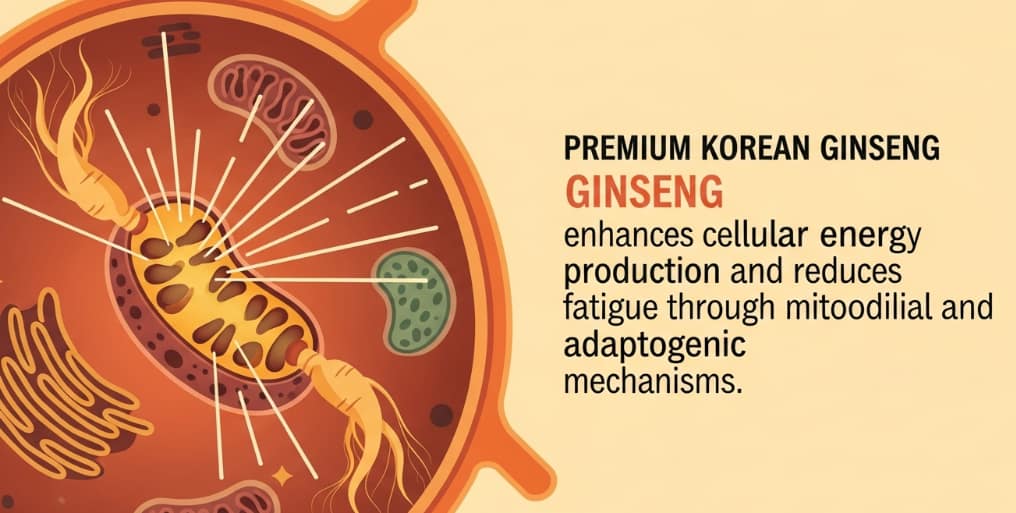
The mitochondria are the “powerhouses” of the cell, producing ATP (adenosine triphosphate) — the body’s main energy currency. Korean Ginseng enhances mitochondrial biogenesis and improves ATP synthesis efficiency.
🔬 Research insight:
A 2019 study published in Nutrients found that Korean Red Ginseng extract increased ATP levels in human skeletal muscle cells, improving overall energy output and reducing oxidative damage.
This mechanism supports long-term vitality rather than providing a short-lived stimulant effect like caffeine.
2. Reducing Oxidative Stress and Inflammation
Chronic fatigue is often linked to oxidative stress, which damages mitochondria and impairs energy production. Ginsenosides act as potent antioxidants, neutralizing free radicals and promoting detoxification pathways in the liver and muscles.
In addition, Korean Ginseng reduces inflammatory cytokines (IL-1β, IL-6, TNF-α), preventing the low-grade inflammation often seen in people with chronic fatigue syndrome.
3. Supporting the Hypothalamic–Pituitary–Adrenal (HPA) Axis
Stress drains energy reserves by overactivating the HPA axis, leading to high cortisol levels and adrenal fatigue.
Korean Ginseng functions as an adaptogen — it helps normalize cortisol production, improving resilience to physical and emotional stress. This allows the body to recover faster and maintain steady energy throughout the day.
🔬 Study evidence:
In a randomized, placebo-controlled trial (Phytotherapy Research, 2020), subjects taking Korean Red Ginseng for 8 weeks showed significantly lower fatigue scores and reduced cortisol compared to placebo.
4. Improving Oxygen Utilization and Circulation
Korean Ginseng increases nitric oxide (NO) production, enhancing blood flow and oxygen delivery to muscles and organs. This mechanism supports endurance and prevents energy crashes during exercise or long work hours.
Athletes often report improved recovery and reduced muscle soreness when supplementing with Korean Ginseng.
5. Boosting Brain Energy and Cognitive Clarity
Mental fatigue often accompanies physical tiredness. Korean Ginseng’s nootropic properties improve focus, attention, and memory. By increasing glucose uptake in the brain and supporting neurotransmitter balance (dopamine, acetylcholine), it enhances mental energy and alertness.
🔬 Clinical data:
A study published in Psychopharmacology found that 200 mg of Panax ginseng extract improved mental arithmetic performance and reaction time in healthy adults experiencing stress-related fatigue.
Clinical Evidence Supporting Anti-Fatigue Effects
| Study | Participants | Duration | Results |
|---|---|---|---|
| Reay et al., Psychopharmacology (2010) | 52 adults with mild fatigue | 8 weeks | Improved cognitive performance, reduced fatigue levels |
| Kim et al., Nutrients (2018) | 90 adults with chronic fatigue | 12 weeks | Significant reduction in fatigue severity scale (FSS) |
| Cho et al., Journal of Ginseng Research (2021) | 70 shift workers | 6 weeks | Improved energy, reduced cortisol, better sleep quality |
These studies consistently demonstrate that Korean Ginseng helps sustain energy, reduce fatigue, and enhance recovery without overstimulation.
How to Use Korean Ginseng for Energy
Recommended Dosage
- Standardized Red Ginseng Extract: 200–400 mg/day
- Fermented Ginseng (Compound K): 100–200 mg/day
- Tea or Capsule Form: 1–2 servings daily
Consistency is key — benefits typically appear after 4–8 weeks of use.
Safety Profile
Korean Ginseng is generally safe when used within recommended doses. Mild side effects (rare) include insomnia or mild headache, often linked to overuse. Avoid taking it too close to bedtime.
Combining Korean Ginseng with Lifestyle for Lasting Energy
To maximize results:
- 🥗 Eat balanced meals: Include complex carbs, lean proteins, and healthy fats.
- 💧 Stay hydrated: Dehydration worsens fatigue.
- 🧘 Manage stress: Use breathing techniques or meditation.
- 💤 Prioritize sleep: Quality rest enhances energy metabolism.
- 🚶 Stay active: Regular movement improves circulation and mitochondrial efficiency.
Korean Ginseng complements these habits by promoting holistic energy balance — physically, mentally, and emotionally.
Future Research and Innovations
Emerging studies focus on:
- Fermented Red Ginseng: Enhanced bioavailability and faster absorption.
- Ginseng + CoQ10 blends: Synergistic mitochondrial support.
- Energy metabolism genomics: Understanding how ginseng interacts with cellular genes controlling fatigue resistance.
These advancements may soon refine personalized energy supplements using Korean Ginseng as a core ingredient.
Conclusion
Korean Ginseng is far more than a traditional herbal remedy — it’s a scientifically validated natural energy enhancer. Through its effects on mitochondria, antioxidant defense, and stress adaptation, it provides sustainable vitality without overstimulation.
Whether you’re battling work-related fatigue, athletic burnout, or mental exhaustion, Korean Ginseng offers a safe, evidence-backed way to restore energy, clarity, and balance.
Experience the difference of true vitality — powered by nature, proven by science.
🇰🇷 Premium Korean Ginseng Online Shop


