
1. Introduction: The Science Behind a Legendary Root
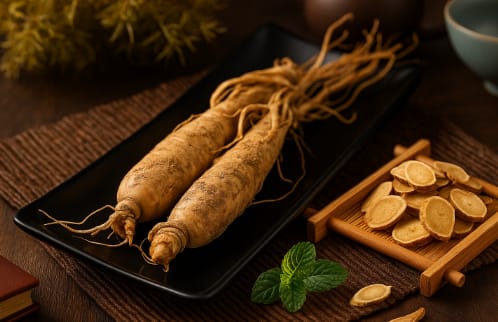
For centuries, ginseng has been celebrated as a symbol of vitality and longevity in East Asian medicine. Among its various forms — Korean, Chinese, American, and Siberian — one stands above the rest in both scientific validation and therapeutic potency: Korean Red Ginseng (Panax ginseng C.A. Meyer).
The secret to its exceptional health benefits lies in its unique bioactive compounds known as ginsenosides — a diverse family of saponins responsible for most of the pharmacological effects attributed to ginseng.
In recent decades, extensive biochemical and clinical research has revealed that the concentration, diversity, and bioactivity of ginsenosides in Korean Red Ginseng far surpass those found in other species, explaining its unmatched role in human health optimization, from energy regulation to neuroprotection.
2. What Are Ginsenosides?
Ginsenosides are a class of naturally occurring triterpene saponins — secondary metabolites produced by the Panax genus to protect the plant from environmental stressors such as UV radiation, pathogens, and temperature extremes.
Structurally, ginsenosides share a four-ring hydrophobic steroidal backbone, similar to that of cholesterol or steroid hormones, attached to sugar moieties that determine their solubility and biological activity.
To date, over 100 distinct ginsenosides have been identified and categorized into two main groups:
- Protopanaxadiol (PPD) group — including Rb1, Rb2, Rc, and Rd, known for anti-fatigue, neuroprotective, and glucose-regulating properties.
- Protopanaxatriol (PPT) group — including Rg1, Re, Rf, and Rh1, recognized for enhancing cognitive function, alertness, and immune modulation.
Each ginsenoside exhibits a unique pharmacokinetic profile — influencing how it is absorbed, metabolized, and utilized in the human body.
3. Biochemical and Pharmacological Actions
Ginsenosides interact with multiple cellular targets, making them pleiotropic agents — compounds that act on different systems simultaneously.
Key Mechanisms:
- Regulation of the HPA axis (Hypothalamic–Pituitary–Adrenal System):
Helps the body adapt to stress by modulating cortisol and adrenaline levels. - Antioxidant and Anti-inflammatory Effects:
Ginsenosides suppress the production of pro-inflammatory cytokines (IL-6, TNF-α) and enhance endogenous antioxidant enzymes such as superoxide dismutase (SOD) and glutathione peroxidase. - Neuroprotective Activity:
Compounds like Rg1 and Rb1 improve neuronal survival, increase acetylcholine synthesis, and reduce β-amyloid accumulation — mechanisms relevant in Alzheimer’s prevention. - Energy Metabolism and Mitochondrial Biogenesis:
Ginsenosides activate AMP-activated protein kinase (AMPK), boosting cellular energy efficiency and endurance. - Immunomodulation:
Ginsenosides enhance macrophage activity and promote balanced immune responses without overstimulation.
4. Why Korean Red Ginseng Contains Higher Ginsenoside Potency
The potency of ginsenosides depends on multiple factors: plant species, cultivation method, soil minerals, climate, and post-harvest processing.
Korean Red Ginseng (Panax ginseng C.A. Meyer), cultivated primarily in the nutrient-rich mountain soils of Geumsan and Punggi, South Korea, excels in every criterion.
a. Species and Genetic Expression
Panax ginseng expresses a broader genetic diversity of ginsenoside biosynthetic enzymes compared to Panax quinquefolius (American ginseng) or Panax notoginseng (Chinese ginseng).
This results in higher production of rare, highly bioactive ginsenosides such as Rg3, Rg5, and Rk1 — compounds associated with anti-cancer and anti-fatigue properties.
b. Steaming and Fermentation Process
The transformation from fresh ginseng to red ginseng is achieved by steaming at 90–100°C for several hours, a process unique to Korean tradition.
This heat processing chemically converts major ginsenosides (like Rb1, Rc, Rd) into more absorbable rare ginsenosides (Rg3, Rh2, Rk1, and Rg5).
These rare forms exhibit higher membrane permeability, making them more bioavailable and pharmacologically potent in humans.
c. Soil and Climate
Korea’s cold winters and hot summers create seasonal stress conditions that stimulate the plant’s defensive metabolism — increasing ginsenoside synthesis.
In contrast, ginseng grown in milder climates (like parts of China or Canada) tends to develop lower saponin density due to less environmental stress.
d. Harvest Age
Korean Red Ginseng is harvested at six years of growth, when ginsenoside concentration reaches its biological peak.
American ginseng is often harvested at 3–4 years, yielding smaller roots with less biochemical maturity.
5. Comparative Analysis: Korean vs. Other Ginseng Species
| Ginseng Type | Scientific Name | Major Ginsenosides | Dominant Group | Pharmacological Focus | Average Ginsenoside Yield |
|---|---|---|---|---|---|
| Korean Red Ginseng | Panax ginseng C.A. Meyer | Rg1, Rb1, Rg3, Rg5, Rh2 | PPD & PPT | Adaptogenic, Anti-fatigue, Neuroprotective | 6–8% of dry weight |
| American Ginseng | Panax quinquefolius | Rb1, Re | PPD | Calming, Glucose-regulating | 3–5% |
| Chinese Ginseng | Panax notoginseng | Rg1, Rb1, Rg2 | PPT | Circulation, Hemostasis | 3–4% |
| Siberian “Ginseng” | Eleutherococcus senticosus | Eleutherosides (non-ginsenoside) | — | Mild adaptogen | <1% (no true ginsenosides) |
Korean Red Ginseng consistently demonstrates the highest total saponin concentration and the broadest spectrum of bioactive ginsenosides — factors that directly correlate with its superior therapeutic efficacy.
6. Mechanisms of Bioactivity in Humans
The pharmacokinetics of ginsenosides vary depending on their chemical structure.
Once ingested, these molecules undergo transformation by intestinal microbiota into secondary metabolites such as Compound K, which exhibit stronger biological effects.
a. Neuroendocrine Regulation
Rg1 and Rb1 act on hippocampal neurons to enhance cognitive performance, reduce fatigue, and balance neurotransmitter activity.
b. Metabolic Regulation
Ginsenoside Rg3 improves insulin sensitivity and lipid metabolism, supporting glucose control in prediabetic individuals.
c. Cardiovascular Protection
Rare ginsenosides (Rg5, Rh2) induce vasodilation by stimulating nitric oxide (NO) production in endothelial cells — reducing blood pressure and improving circulation.
d. Immunomodulation
Rh1 and Rg2 enhance the production of immunoglobulins and stabilize immune homeostasis, making Korean Red Ginseng effective in reducing inflammation without compromising defense mechanisms.
7. Clinical Studies Supporting Superior Potency
Numerous peer-reviewed studies substantiate the claim that Korean Red Ginseng exhibits stronger physiological benefits due to its higher ginsenoside diversity.
- Kim et al., 2018 (Journal of Ginseng Research):
Demonstrated that steamed Korean Red Ginseng contained 2.4× higher Rg3 levels than unprocessed roots, significantly improving fatigue resistance and mental alertness. - Ahn et al., 2020 (Nutrients):
Found that daily supplementation of Korean Red Ginseng (2g/day for 12 weeks) reduced oxidative stress markers by 25% and improved sleep quality in adults aged 40–65. - Lee et al., 2019 (Frontiers in Pharmacology):
Showed that Rg3-enriched Korean Red Ginseng improved endothelial function and reduced systolic blood pressure in hypertensive patients. - Oh et al., 2021 (Phytotherapy Research):
Compared Korean, American, and Chinese ginseng extracts — revealing that Korean Red Ginseng exhibited the strongest antioxidant and neuroprotective outcomes in vitro and in vivo.
8. Therapeutic Implications
Due to its biochemical superiority, Korean Red Ginseng is recognized globally as a functional adaptogenic herb with applications across multiple domains:
- Cognitive Function: Enhances memory, learning, and attention
- Anti-Fatigue: Supports ATP synthesis and muscle endurance
- Cardiovascular Health: Regulates blood pressure and lipid profiles
- Metabolic Support: Improves insulin sensitivity
- Immunity: Modulates innate and adaptive immune responses
- Stress Resilience: Balances HPA-axis activity
- Longevity: Protects cellular DNA from oxidative damage
In short, ginsenosides are not isolated compounds — they form a synergistic pharmacological network, making Korean Red Ginseng a uniquely comprehensive tonic for modern health challenges.
9. Conclusion
Scientific evidence consistently confirms that Korean Red Ginseng possesses the highest concentration, diversity, and bioavailability of ginsenosides among all ginseng species.
Its unique genetic makeup, six-year cultivation cycle, and traditional steaming process produce rare ginsenosides like Rg3, Rh2, and Rk1 — compounds scarcely found in other ginsengs but crucial for its multi-system benefits.
From cellular energy metabolism to neuroendocrine balance, the biochemical architecture of Korean Red Ginseng offers unmatched potency — not as a stimulant, but as a true adaptogen that restores equilibrium across the body’s systems.
For those seeking evidence-based, natural solutions for fatigue, cognition, immunity, or aging, Korean Red Ginseng stands as the gold standard of adaptogenic science.
🇰🇷 Premium Korean Ginseng Online Shop


