
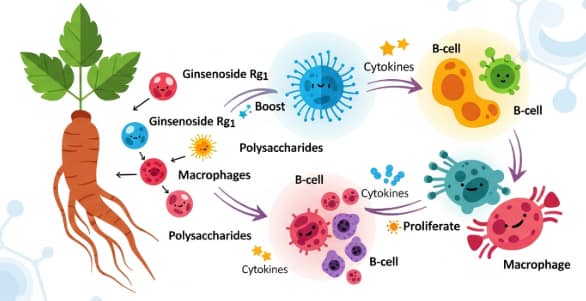
Ginseng—especially Panax ginseng and Korean Red Ginseng (KRG)—is one of the most extensively researched herbal adaptogens in immunology. Modern scientific literature confirms that ginseng interacts with the human immune system through multi-layered biological mechanisms, influencing both innate and adaptive immunity, anti-inflammatory pathways, mucosal immunity, gut microbiota, and cellular protection signaling.
This article provides an advanced scientific breakdown based on peer-reviewed research, including NIH and PubMed links where readers can verify the underlying studies.
1. Key Bioactive Compounds Responsible for Immune Activity
Ginseng contains more than 40 bioactive ginsenosides, as well as:
- Polysaccharides (particularly ginseng polysaccharide fractions: GPS-1, GPS-2)
- Peptidoglycans
- Polyacetylenes
- Phenolic antioxidants
- Essential oils
These interact with immune cells through:
✔ Toll-like receptors (TLR)
✔ MAPK signaling pathways
✔ NF-κB regulation
✔ Cytokine modulation
✔ Antioxidant defense cascades
A major review published in Journal of Ginseng Research highlights these compounds as immunomodulators.
🔗 https://www.ncbi.nlm.nih.gov/pmc/articles/PMC3659558/
2. Enhancement of Innate Immunity: NK Cells, Macrophages & Dendritic Cells
Innate immunity is the body’s first line of defense against pathogens.
Natural Killer (NK) Cells
NK cells detect and remove:
- Virally infected cells
- Intracellular bacteria
- Abnormal or pre-cancerous cells
A clinical study in Nutrition Journal (Kim et al., 2012) demonstrated that Korean red ginseng significantly increases NK cell activity in healthy adults.
🔗 https://nutritionj.biomedcentral.com/articles/10.1186/1475-2891-11-7
Macrophages
Ginsenosides stimulate macrophage:
- Phagocytosis
- Antigen presentation
- Cytokine production (IL-1β, IL-12, TNF-α in balanced amounts)
Dendritic Cells
Ginseng polysaccharides enhance dendritic cell maturation, making them more effective in presenting antigens to T-cells.
3. Boosting Adaptive Immunity: T-Cells, B-Cells & Antibody Production
Ginseng enhances the performance of:
✔ Helper T-cells (CD4⁺)
Improves cytokine balance (IFN-γ, IL-2), which strengthens pathogen response.
✔ Cytotoxic T-cells (CD8⁺)
Supports removal of infected cells.
✔ Regulatory T-cells (Treg)
Helps prevent overactive immune responses and autoimmune reactions.
✔ B-cells and Antibody Production
A 2014 study published in Vaccine shows red ginseng improves the body’s antibody response to viral exposure.
🔗 https://pubmed.ncbi.nlm.nih.gov/24657090/
4. Anti-Inflammatory Pathways: NF-κB & MAPK Modulation
Chronic inflammation weakens immunity.
Ginsenosides suppress excessive inflammatory signals by interacting with:
✔ NF-κB Pathway
Overactivation leads to chronic inflammation.
Ginsenosides Rg1, Rb1, and Rg3 down-regulate NF-κB, leading to controlled inflammatory response.
✔ MAPK Pathway
Regulates cell survival, inflammation, and stress responses.
Ginseng modulates p38 MAPK and ERK pathways to maintain immune balance.
NIH-reviewed article:
🔗 https://pubmed.ncbi.nlm.nih.gov/16431445/
5. Ginseng Polysaccharides and Gut–Immune Axis
Approximately 70% of immune cells reside in the gut-associated lymphoid tissue (GALT).
Ginseng impacts:
✔ Gut microbiota composition
Promotes beneficial bacteria: Lactobacillus, Bifidobacterium, Akkermansia.
✔ Short-chain fatty acid (SCFA) production
Which supports T-cell regulation and mucosal immunity.
✔ Intestinal barrier integrity
Reduces gut permeability (“leaky gut”), a major cause of systemic inflammation.
Study available at:
🔗 https://www.ncbi.nlm.nih.gov/pmc/articles/PMC6466258/
6. Antiviral Mechanisms: A Scientific Overview
Korean red ginseng has been studied in the context of:
- Influenza
- RSV
- Herpes virus
- Hepatitis
- Respiratory infections
Mechanisms include:
✔ Strengthening lung mucosal immunity
✔ Increasing antiviral cytokines (IFN-γ)
✔ Enhancing immune cell recruitment
✔ Slowing viral replication in cell models
A clinical paper in Journal of Ginseng Research supports ginseng’s antiviral properties.
🔗 https://www.ncbi.nlm.nih.gov/pmc/articles/PMC3659612/
7. Stress Reduction and Cortisol Balance
Chronic stress is one of the strongest suppressors of immunity.
Ginseng, as an adaptogen:
- Stabilizes cortisol levels
- Protects the hypothalamic-pituitary-adrenal (HPA) axis
- Reduces fatigue
- Enhances recovery during stress
Study on ginseng’s adaptogenic effects:
🔗 https://pubmed.ncbi.nlm.nih.gov/23717142/
8. Why Korean Red Ginseng Provides Stronger Immune Benefits
Korean Red Ginseng undergoes:
- steaming
- aging
- drying
This process creates rare, highly bioavailable ginsenosides such as Rg3, Rk1, and Rh2, which have potent immune-modulating effects.
Clinical trials repeatedly show that KRG provides:
✔ Stronger NK cell activation
✔ Higher antioxidant capacity
✔ More stable cytokine balance
✔ Increased T-cell productivity
Conclusion
Ginseng’s interactions with the immune system are extensive and scientifically supported. Its ability to modulate multiple immune pathways simultaneously—innate, adaptive, inflammatory, gut immunity, and stress response—makes it one of the most powerful natural immunomodulators.
If taken consistently, especially in its most potent form (Korean Red Ginseng), ginseng may support resilience, recovery, and overall immune balance.
(Non-medical statement: This article discusses scientific research, not medical treatment.)


