
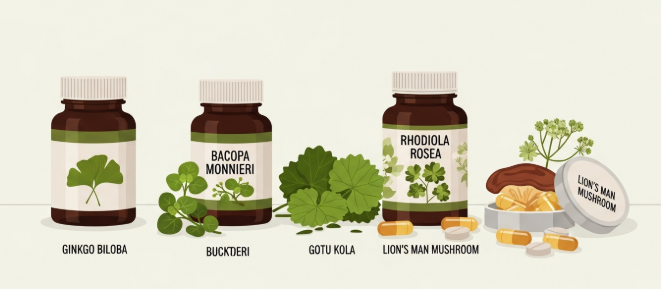
Introduction
Maintaining mental clarity is increasingly challenging in modern life. Long work hours, digital overload, and chronic stress all affect attention. As a result, interest in herbal supplements for focus and concentration continues to grow. Many people seek natural options to support cognitive performance while avoiding excessive stimulant use. This article provides an evidence-based, medically responsible overview of commonly studied herbal supplements, their mechanisms, safety considerations, and practical guidance, aligned with Google Health and E-E-A-T standards.
Importantly, herbal supplements are not substitutes for medical care. However, when used appropriately, some botanicals may support attention and mental stamina as part of a healthy lifestyle.
Understanding Focus and Concentration from a Medical Perspective
Focus and concentration rely on complex brain processes. Neurotransmitters such as dopamine, acetylcholine, and norepinephrine play central roles. Adequate cerebral blood flow, mitochondrial energy production, and stress regulation also matter.
When these systems are disrupted, concentration declines. Common contributing factors include:
- Sleep deprivation
- Chronic psychological stress
- Nutrient deficiencies
- High cognitive workload
- Aging-related neurochemical changes
Therefore, effective herbal supplements for focus and concentration usually target one or more of these pathways rather than acting as simple stimulants.
How Herbal Supplements May Support Cognitive Function
Herbal supplements influence cognition through several mechanisms. Understanding these mechanisms helps set realistic expectations.
Key mechanisms include:
- Neurotransmitter modulation: Supporting acetylcholine or dopamine activity
- Adaptogenic effects: Improving stress resilience and mental endurance
- Improved cerebral circulation: Enhancing oxygen and nutrient delivery
- Antioxidant activity: Protecting neurons from oxidative stress
- Neuroprotective effects: Supporting long-term brain health
Institutions such as the National Institutes of Health (NIH) and research indexed in PubMed emphasize that these effects are typically mild to moderate and vary between individuals.
Evidence-Based Herbal Supplements for Focus and Concentration
Below are herbal supplements with the most consistent scientific support. They are discussed using cautious, medically appropriate language.
1. Bacopa monnieri
Bacopa monnieri is a traditional Ayurvedic herb studied for cognitive support.
Evidence highlights:
- May improve attention and information processing speed
- Effects often appear after 8–12 weeks of consistent use
Clinical trials published in Journal of Ethnopharmacology suggest modest benefits, particularly for memory and sustained attention.
Safety note: Gastrointestinal discomfort may occur in sensitive individuals.
2. Ginkgo biloba
Ginkgo biloba is widely researched for its effects on cerebral circulation.
Potential benefits:
- Supports blood flow to the brain
- May help attention in older adults
A review in Human Psychopharmacology indicates mixed results. Benefits appear more pronounced in individuals with age-related cognitive decline.
Caution: Ginkgo may interact with blood-thinning medications.
3. Rhodiola rosea
Rhodiola is classified as an adaptogen. It helps the body manage stress.
Research findings:
- May reduce mental fatigue
- Supports concentration under stress
Studies referenced by the World Health Organization (WHO) monographs show improved performance during demanding cognitive tasks.
Best use: Periods of high mental workload rather than daily long-term use.
4. Lion’s Mane Mushroom (Hericium erinaceus)
Although technically a medicinal mushroom, Lion’s Mane is often grouped with herbal supplements.
Mechanism of action:
- Supports nerve growth factor (NGF) synthesis
- May support neuroplasticity
Preliminary human studies in Biomedical Research suggest improved cognitive function with regular intake.
Safety profile: Generally well tolerated.
5. Gotu Kola (Centella asiatica)
Gotu Kola has traditional use in Asian medicine for mental clarity.
Potential effects:
- Mild anxiolytic activity
- Supports attention through stress reduction
Evidence remains limited, but early studies indicate possible benefits when combined with healthy sleep and nutrition.
Comparison Table: Popular Herbal Supplements for Focus
| Herbal Supplement | Primary Benefit | Best For | Evidence Strength |
|---|---|---|---|
| Bacopa monnieri | Memory, attention | Long-term cognitive support | Moderate |
| Ginkgo biloba | Cerebral circulation | Age-related focus decline | Moderate |
| Rhodiola rosea | Mental endurance | Stress-related fatigue | Moderate |
| Lion’s Mane | Neuroprotection | Long-term brain health | Emerging |
| Gotu Kola | Calm focus | Stress-sensitive individuals | Limited |
Safety, Dosage, and Medical Considerations
Safety is central when discussing herbal supplements for focus and concentration. Natural does not automatically mean risk-free.
General safety guidelines:
- Choose standardized extracts from reputable manufacturers
- Avoid combining multiple cognitive supplements without guidance
- Start with the lowest effective dose
- Monitor for side effects
Certain populations should exercise caution, including:
- Pregnant or breastfeeding individuals
- People with neurological or psychiatric conditions
- Those taking prescription medications
The NIH and European Medicines Agency emphasize consulting a healthcare professional before long-term supplementation.
Integrating Herbal Supplements into a Cognitive Health Plan
Herbal supplements work best when combined with lifestyle strategies. Evidence consistently shows that supplements alone offer limited benefits.
Supportive strategies include:
- Consistent sleep schedules
- Adequate protein and micronutrient intake
- Regular physical activity
- Mindfulness or stress management techniques
When these foundations are in place, herbal supplements for focus and concentration may provide additional support rather than acting as primary solutions.
What About Korean Ginseng?
Korean ginseng (Panax ginseng) is often discussed in cognitive health. However, evidence suggests its effects on focus are mild and context-dependent. Some studies indicate short-term improvements in mental performance, possibly due to fatigue reduction rather than direct cognitive enhancement.
For this reason, Korean ginseng should be viewed as a complementary option, not a primary intervention, and only used under professional guidance.
Scientific References and Authoritative Sources
For further reading, consult the following reputable sources:
- National Institutes of Health (NIH): https://www.nih.gov
- PubMed database: https://pubmed.ncbi.nlm.nih.gov
- World Health Organization Monographs on Medicinal Plants
- Journal of Ethnopharmacology
- Human Psychopharmacology: Clinical and Experimental
These institutions provide peer-reviewed, continuously updated research on herbal medicine and cognitive health.
Conclusion
Interest in herbal supplements for focus and concentration reflects a broader desire for safe, natural cognitive support. Current evidence supports modest benefits from select herbs, particularly when used consistently and responsibly. However, results vary, and no supplement replaces sleep, nutrition, or medical care.
A healthcare professional should always be consulted before beginning supplementation. When integrated thoughtfully, herbal supplements may support attention and mental endurance as part of a comprehensive brain health strategy.
Read also: Ginseng for Focus and Concentration: Evidence-Based Benefits, Safety, and How to Use Korean Ginseng